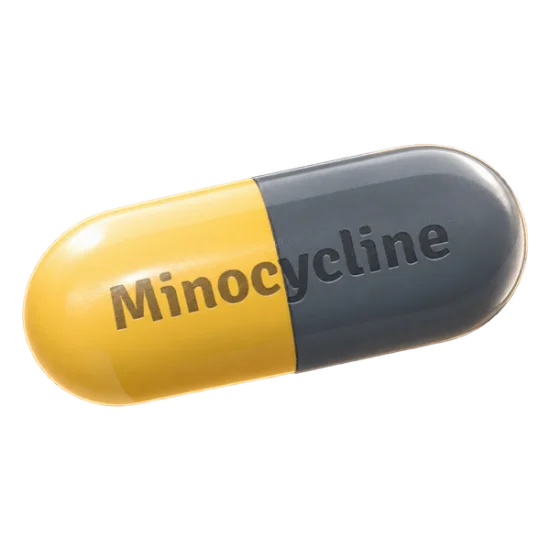
I used the prescribed amount for inflammatory acne on my back. After about a month, fewer new painful spots appeared. I felt dizzy during the first week, so I stopped driving until that settled.
Minocycline
Inflammatory acne vulgaris may require an oral tetracycline when topical treatment has not controlled deeper lesions. Minocycline contains the tetracycline antibiotic minocycline and reduces bacterial protein production plus inflammation around blocked follicles. It is used for selected moderate-to-severe acne cases under an individualized prescribing plan.
About this product
Minocycline belongs to the tetracycline antibiotic class. The active antibacterial substance is minocycline, supplied here as oral capsules. Dermatologists may prescribe it for inflammatory acne vulgaris when topical medicines alone have produced insufficient improvement or when lesions are widespread, tender, or at risk of scarring.
Pharmacological action
Minocycline enters susceptible bacteria and binds to the 30S ribosomal subunit. This interferes with the attachment of transfer RNA and interrupts peptide-chain elongation. Without normal protein synthesis, bacterial growth slows.
The drug also has anti-inflammatory effects relevant to acne. It can reduce inflammatory signalling and the activity of enzymes involved in tissue irritation around pilosebaceous units. The pilosebaceous unit is the hair follicle together with its attached sebaceous gland, where excess oil, follicular blockage, bacterial activity, and inflammation interact.
Minocycline is more lipid-soluble than older tetracyclines. That property helps it distribute into tissues, including areas associated with sebaceous glands. Tissue penetration does not mean that a higher dose gives better acne control. More exposure can increase adverse effects without producing a proportional skin benefit.
The pharmacological distinction from topical antibiotics is important. A topical product acts mainly at the application site, while oral minocycline creates systemic exposure. This explains both its usefulness for widespread acne and the need to assess dizziness, pigmentation, autoimmune symptoms, and drug interactions.
What it contains
The active antibacterial substance is minocycline, supplied here as oral capsules.
Directions for use
- Route: Take Minocycline orally as a capsule.
- Dose: The amount per intake is set individually for each person; no single dose in mg is established here.
- Frequency: Take it according to the prescriber’s individualized plan; the number of doses per day is not established here.
- Timing: Follow the prescribed schedule; timing in relation to meals is not established here.
- Duration: Use it for the defined course selected by the prescriber, based on acne severity, previous treatment, kidney and liver health, other medicines, response, and tolerability.
Reasons not to use it
- A previous serious allergy to minocycline or another tetracycline.
- Pregnancy, unless a specialist has established a clear reason and safer options are unsuitable.
- Breastfeeding without a specific clinical assessment.
- A history of raised intracranial pressure, especially when associated with tetracycline use.
- Significant liver disease requiring specialist review.
- Symptoms suggesting an active autoimmune reaction linked to prior minocycline treatment.
Important interactions include:
- Oral retinoids, such as isotretinoin, because the combination may increase the risk of raised intracranial pressure.
- Antacids and mineral supplements containing aluminium, calcium, magnesium, iron, or zinc, which may reduce absorption.
- Warfarin and related anticoagulants, because antibiotic treatment can alter anticoagulant response.
- Medicines that affect the liver, when combined exposure may increase hepatic risk.
- Other antibiotics, where unnecessary combination therapy can increase adverse effects and resistance pressure.
When this is not for you
This treatment is not for you if you have:
- A previous serious allergy to minocycline or another tetracycline.
- Pregnancy, unless a specialist has established a clear reason and safer options are unsuitable.
- Breastfeeding without a specific clinical assessment.
- A history of raised intracranial pressure, especially when associated with tetracycline use.
- Significant liver disease requiring specialist review.
- Symptoms suggesting an active autoimmune reaction linked to prior minocycline treatment.
Tetracyclines can affect developing teeth and bone. For that reason, use in children under 8 years is generally avoided unless a specialist determines that the clinical benefit outweighs the risk. Use in adolescents requires attention to age, pregnancy possibility, and the specific indication.
Seek urgent care for severe headache with blurred or double vision, facial swelling, breathing difficulty, blistering skin, yellow eyes, dark urine, or fainting.
Adverse reactions
Minocycline can cause adverse drug reactions affecting the digestive system, nervous system, skin, and immune system. Some reactions appear early, while others are associated with prolonged exposure.
Commonly reported problems include:
- Nausea, stomach discomfort, loose stools, or indigestion.
- Headache or dizziness.
- Light-headedness or a spinning sensation, especially after starting treatment.
- Increased sensitivity to sunlight.
- Oral or genital fungal overgrowth after antibiotic exposure.
- Darkening of the skin, gums, nails, teeth, or areas of previous inflammation.
Dizziness deserves practical attention. A person may feel unsteady when standing, driving, or turning the head. The symptom can improve after the body adjusts, but driving or operating machinery is unsafe while balance or vision feels impaired.
Pigmentation may look blue-grey, brown, or slate-coloured. It can affect scars, shins, gums, nails, or areas exposed to inflammation. A small dark line near the nail or a new colour change inside the mouth is easy to dismiss as cosmetic. It should be reported promptly because continuing treatment may allow the change to become more persistent.
Rare reactions can be serious:
- Drug-induced lupus erythematosus, with joint pain, fatigue, fever, chest discomfort, or a sun-sensitive rash.
- Autoimmune hepatitis, which may cause unusual tiredness, nausea, abdominal discomfort, dark urine, or yellowing of the skin.
- Severe skin reactions with blistering, peeling, mouth sores, or widespread rash.
- Raised intracranial pressure, associated with severe headache, visual symptoms, or vomiting.
- Severe allergic reactions involving facial swelling, breathing difficulty, or collapse.
The risk of autoimmune reactions tends to increase with longer duration of use. Minocycline-associated lupus has been linked with prolonged exposure in clinical reports, so continuing treatment for months without review is poor practice. The FDA prescribing information describes these systemic risks and the need for clinical assessment when warning symptoms appear [2].
| Reaction pattern | Practical response |
|---|---|
| Nausea, loose stools, headache, or dizziness | Take with water, avoid driving if dizzy, and report persistent symptoms |
| New blue-grey or brown pigmentation | Arrange a medication review before continuing a prolonged course |
| Joint pain, fever, dark urine, jaundice, severe rash, or vision changes | Seek urgent medical assessment |
Uses
Dermatologists may prescribe it for inflammatory acne vulgaris when topical medicines alone have produced insufficient improvement or when lesions are widespread, tender, or at risk of scarring.
Acne treatment aims to reduce inflammatory papules, pustules, and deeper lesions. Minocycline is usually considered for a defined course. The prescriber chooses the amount per intake for the individual patient, taking account of age, acne severity, previous treatment, kidney and liver health, and other medicines.
Acne guidelines from NICE place oral antibiotics within a broader treatment plan rather than as indefinite monotherapy [1].
Comparison
Minocycline, doxycycline, lymecycline, tetracycline, and oxytetracycline all belong to related antibiotic families, but their tolerability, dosing schedules, interactions, and tissue distribution differ. Oral isotretinoin works through a different pathway and is reserved for severe, scarring, or treatment-resistant acne under specialist supervision.
| Treatment approach | Main clinical distinction |
|---|---|
| Minocycline or doxycycline | Oral tetracycline treatment for inflammatory acne; minocycline may cause more vestibular and pigmentation problems |
| Lymecycline or tetracycline | Related oral antibiotic options with different pharmacokinetic and tolerability profiles |
| Oral isotretinoin | Retinoid treatment for severe or persistent acne; requires strict pregnancy-prevention and laboratory monitoring |
Randomised comparisons have not shown that a stronger adverse-effect profile automatically produces better long-term outcomes. Doxycycline is often selected when clinicians want a tetracycline with a more familiar tolerability profile, while minocycline may be considered when its tissue distribution and prior response are useful. Photosensitivity can occur with tetracyclines, and food or mineral interactions vary by product.
Erythromycin may be used in selected circumstances, such as when tetracyclines are unsuitable, but resistance patterns limit its usefulness. Combining oral antibiotics without a specific clinical reason adds exposure and does not represent a routine acne strategy. Oral isotretinoin can be more definitive for severe nodulocystic acne, yet its monitoring and pregnancy-related restrictions are substantially greater.
The European Medicines Agency has highlighted antimicrobial stewardship as a public-health priority. An oral antibiotic should have a defined purpose, a review point, and an accompanying acne strategy rather than being continued automatically.
Common mistakes
Several avoidable habits make treatment less tolerable or less useful:
- Taking a capsule with only a sip of water and lying down immediately afterward.
- Using iron, calcium, magnesium, zinc, or antacid products close to the dose without checking for an interaction.
- Continuing treatment for months without a review.
- Treating dizziness as harmless while driving or using machinery.
- Stopping topical acne treatment as soon as oral therapy begins, even though combination treatment may be part of the plan.
- Applying intense sun exposure without protection.
- Doubling the next dose after forgetting one.
- Ignoring darkened gums, nails, scars, or skin.
- Continuing despite severe headache, visual disturbance, jaundice, or a widespread blistering rash.
Minerals can bind tetracycline antibiotics in the gut and reduce absorption. The appropriate separation interval depends on the specific product and supplement, so the timing should be set by a prescriber or pharmacist who knows the exact medicines involved.
What doctors say
In clinical practice, dermatologists usually assess three features before choosing oral minocycline: the number and type of inflammatory lesions, the presence of scarring or deep nodules, and the results of previous topical treatment. A patient with mild comedonal acne may receive a different approach from someone with painful lesions across the face, chest, and back.
A practical prescribing pattern is to define the intended course before the first capsule is taken. The response is judged by fewer new inflammatory lesions, less tenderness, and reduced spread, not only by whether old marks have faded. Post-inflammatory pigmentation can remain after active acne has settled. Review timing should be agreed before treatment begins. The plan should also include what to do if adverse effects appear.
Patients sometimes expect a rapid cosmetic change. Oral antibiotics usually need time to reduce inflammation, and the first sign of benefit may be fewer new painful lesions rather than immediately clearer skin.
Questions and answers
What is the best time of day to take Minocycline?
The best time is the one that matches the prescribed schedule and can be taken consistently with a full glass of water. Taking it at the same time each day may reduce missed doses, while remaining upright afterward can reduce throat irritation. Dizziness can occur, so some people prefer a time when they do not need to drive, but the schedule should not be changed without clinical advice. The British Association of Dermatologists discussed oral antibiotic safety in acne guidance published in 2023.
Can alcohol be used while taking Minocycline?
Alcohol is not a reliable way to manage dizziness, nausea, or headache caused by minocycline. Drinking may make light-headedness and stomach irritation more noticeable, and heavy alcohol use can add stress to the liver. Avoid alcohol if you develop unusual fatigue, dark urine, abdominal pain, or yellowing of the skin. The EMA’s tetracycline safety information supports prompt assessment of suspected liver-related symptoms, with its relevant product information reviewed in 2025.
What happens when Minocycline is stopped, and does it need tapering?
Minocycline is generally stopped rather than gradually tapered when the planned course ends or a clinician identifies a significant adverse reaction. Stopping does not cause a classic withdrawal syndrome, although acne activity may return if the underlying condition remains active. Do not restart leftover capsules after a gap because the indication, interactions, and duration may need reassessment. The American Academy of Dermatology acne guidance available in 2024 supports reviewing antibiotic treatment as part of a continuing topical or maintenance plan.
Can Minocycline be combined with medicines or supplements?
Mineral supplements and antacids containing iron, calcium, magnesium, aluminium, or zinc can reduce absorption when taken too close to minocycline. Oral isotretinoin is a separate concern because concurrent use may increase the risk of raised intracranial pressure. Warfarin can also require closer monitoring during antibiotic treatment. The FDA medication information reviewed in 2025 lists these interaction concerns and supports checking the full medicine and supplement list before treatment begins.
Can people under 18 use Minocycline?
Age alone does not determine suitability. Tetracycline antibiotics are generally avoided in children younger than 8 because of effects on developing teeth and bone, while older adolescents may receive minocycline for acne when the clinician considers it appropriate. Pregnancy possibility, liver health, headaches, vision symptoms, and previous reactions still need assessment. WHO guidance published in 2023 supports careful antimicrobial use in children and adolescents according to indication and risk.
Should Minocycline be taken with food or on an empty stomach?
Minocycline may be taken with food when stomach discomfort occurs, but mineral-rich products can interfere with absorption. Milk, calcium supplements, iron tablets, antacids, and multivitamins should not be taken close to the capsule unless the timing has been checked for the specific product. Swallow the capsule with plenty of water and do not take it immediately before lying down. The EMA product information reviewed in 2025 describes food and mineral considerations for oral tetracycline therapy.
Do you offer anonymous delivery?
Your order will be securely packed and shipped within 24 hours. This is exactly what your package will look like (images of an actual item sent). It has the size and look of a regular private letter (24x11x0.7 cm) and its contents cannot be seen.
Comparison
Amoxil
Ampicillin
Augmentin
Bactrim
Ciplox
Cipro
Sources
- NICE (2021). Acne vulgaris: management — NG198
- U.S. Food and Drug Administration (2019). Minocycline hydrochloride capsules: prescribing information