I noticed less jumping between tasks, but the first week brought mild nausea and a dry mouth. Taking the capsule after breakfast made the stomach discomfort easier.
Strattera supports treatment of attention deficit hyperactivity disorder (ADHD) in children, adolescents, and adults. Its active ingredient, atomoxetine, is a non-stimulant selective norepinephrine reuptake inhibitor that can improve attention, impulse control, and executive functioning over time.
About this product
Its active ingredient, atomoxetine, is a non-stimulant selective norepinephrine reuptake inhibitor that can improve attention, impulse control, and executive functioning over time.
Pharmacological action
Atomoxetine selectively inhibits norepinephrine reuptake in the central nervous system. This action increases norepinephrine availability in brain circuits that regulate attention and impulse control.
The prefrontal cortex needs a balanced level of norepinephrine. Too little signalling can make it harder to maintain focus, organise tasks, or resist distractions. Atomoxetine aims to improve this signalling without producing the rapid stimulation associated with amphetamine-based or methylphenidate-based medicines.
Clinical research in adults has also linked atomoxetine treatment with improvements in core ADHD symptoms, though response remains individual [2].
What it contains
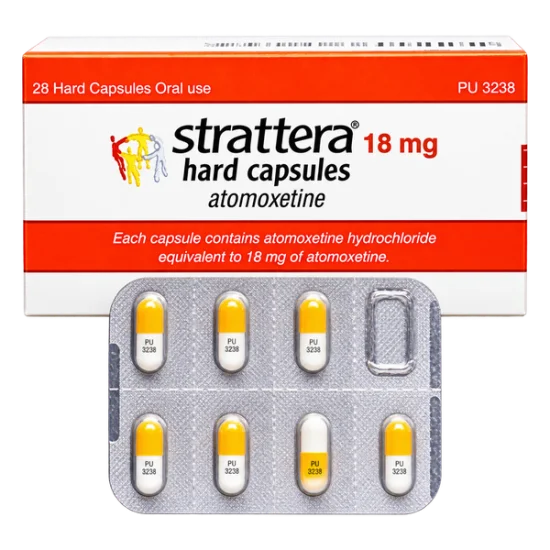
Strattera contains atomoxetine, a selective norepinephrine reuptake inhibitor used for ADHD. The product is supplied as hard capsules for oral use. Atomoxetine is approved for ADHD management in paediatric patients and adults under regulatory prescribing frameworks such as those recognised by the FDA and EMA [1].
Unlike stimulant medicines, atomoxetine does not primarily work by directly increasing dopamine release throughout the brain. It changes norepinephrine signalling in regions involved in attention, planning, working memory, and behavioural control.
Active ingredient and therapeutic role
Atomoxetine blocks the norepinephrine transporter. This reduces the reuptake of norepinephrine after it has been released between nerve cells. The resulting increase in available norepinephrine helps strengthen signalling in the prefrontal cortex, an area involved in concentration and inhibition of impulsive responses.
Strattera is intended for ADHD symptoms such as:
- Difficulty sustaining attention
- Distractibility
- Impulsive behaviour
- Poor task organisation
- Excessive activity or restlessness
- Problems with planning and completing activities
The medicine is not a quick performance enhancer. Its benefits usually develop gradually, and the response can differ between children, adolescents, and adults.
Directions for use
- Dose: Each hard capsule contains 18 mg of atomoxetine; the prescribed amount is agreed with a doctor or pharmacist.
- Frequency: Take the prescribed number of capsules at the frequency agreed with a doctor or pharmacist.
- Timing: Take the capsules orally at the prescribed time; whether to take them before or after meals is agreed with a doctor or pharmacist.
- Duration: Continue treatment for the duration agreed with a doctor or pharmacist, without changing it independently.
- Route: Swallow the hard capsules for oral use as prescribed.
Reasons not to use it
Strattera is not suitable for everyone. It should not be used in people with a known allergy to atomoxetine or any capsule ingredient. It is also contraindicated with monoamine oxidase inhibitors and should not be started until the required interval after an MAOI has passed.
Medical review is needed before treatment in people with:
- Significant heart disease
- Severe high blood pressure
- Fainting or unexplained exercise-related collapse
- Structural heart abnormalities
- Narrow-angle glaucoma
- Severe liver impairment
- Bipolar disorder, psychosis, or a history of severe mood instability
- Suicidal thoughts or recent self-harm
- A family history of sudden cardiac death
- Treatment with strong CYP2D6 inhibitors
The EMA product information advises clinicians to consider maternal benefit, fetal considerations, and available safety information before continuing treatment [4].
When this is not for you
This medication is not for you if you have an atomoxetine allergy, are taking an MAOI, or have an untreated cardiovascular condition that makes increased heart rate or blood pressure unsafe.
Adverse reactions
Atomoxetine can cause side effects, especially during treatment initiation or after a dose increase. Commonly reported reactions include:
- Nausea or stomach discomfort
- Reduced appetite
- Dry mouth
- Headache
- Fatigue or sleepiness
- Difficulty sleeping
- Dizziness
- Increased heart rate
- Increased blood pressure
Some people feel sleepy after taking atomoxetine, while others experience insomnia or restlessness. Taking the medicine at a different time may help, but the schedule should be changed only within the agreed treatment plan.
Appetite reduction can be subtle. A child may not complain but may begin leaving more food unfinished or losing weight. Height, weight, appetite, and growth should be followed during paediatric treatment.
The FDA prescribing information describes rare but serious concerns, including liver injury, allergic reactions, cardiovascular symptoms, and suicidal thinking in children and adolescents [3]. New agitation, unusual irritability, severe mood change, dark urine, yellowing of the skin, fainting, chest pain, or sustained palpitations requires prompt medical assessment.
Fluoxetine, also known as Prozac, and bupropion can inhibit the CYP2D6 enzyme. This may increase atomoxetine exposure and intensify adverse effects. A clinician may use a lower starting approach or allow more time between dose changes when a strong CYP2D6 inhibitor is present.
Albuterol can stimulate the cardiovascular system. Using it with atomoxetine may increase concern about fast heart rate, tremor, or blood pressure changes, especially in a person with an underlying heart condition.
Uses
Strattera supports treatment of attention deficit hyperactivity disorder (ADHD) in children, adolescents, and adults.
Strattera is intended for ADHD symptoms such as:
- Difficulty sustaining attention
- Distractibility
- Impulsive behaviour
- Poor task organisation
- Excessive activity or restlessness
- Problems with planning and completing activities
Comparison
Strattera belongs to the non-stimulant group. Stimulant treatment includes amphetamine-based medicines such as Adderall and Vyvanse, methylphenidate-based medicines such as Ritalin and Concerta, and dexmethylphenidate-based medicines such as Focalin.
| Treatment category | Main pharmacological action | Typical clinical distinction |
|---|---|---|
| Atomoxetine | Selective norepinephrine reuptake inhibition | Gradual benefit without stimulant-type reinforcement |
| Methylphenidate-based medicines | Increase catecholamine signalling by affecting dopamine and norepinephrine transport | Often faster symptom response, with appetite and sleep effects |
| Amphetamine-based medicines | Increase release and reduce reuptake of dopamine and norepinephrine | Strong acute effect, with controlled-substance and misuse considerations |
Stimulants often show a faster onset of symptom relief. They can also cause appetite suppression, insomnia, increased heart rate, or mood changes. Strattera avoids stimulant-type euphoria and is not classified as a controlled stimulant, yet it can still raise heart rate or blood pressure and requires medical monitoring.
A non-stimulant approach may be selected when stimulant adverse effects are troublesome, when misuse risk is a clinical concern, or when symptom coverage across the day is needed without repeated short-acting doses. Stimulants may be preferred when a rapid response is essential and the patient has no relevant contraindication.
Other non-stimulant approaches act through different receptor systems. Guanfacine, marketed in some settings as Intuniv, and clonidine, marketed in some settings as Kapvay, are alpha-2 adrenergic agonists. They can reduce hyperactivity and impulsivity by strengthening prefrontal cortical regulation, while sedation and low blood pressure may limit use.
Bupropion, also known by the brand name Wellbutrin, is an antidepressant sometimes used off-label for ADHD. It affects norepinephrine and dopamine signalling, but its use for ADHD differs from atomoxetine because ADHD is not its primary licensed indication in many jurisdictions.
| Option | Main pathway | Common clinical limitation |
|---|---|---|
| Atomoxetine | Norepinephrine transporter inhibition | Gradual response; nausea, appetite change, or sleep effects may occur |
| Guanfacine or clonidine | Alpha-2 adrenergic receptor activity | Drowsiness, dizziness, and low blood pressure |
| Bupropion | Norepinephrine and dopamine reuptake inhibition | Off-label ADHD use; seizure risk in susceptible patients |
A physician may choose Strattera when a non-stimulant mechanism is preferred and atomoxetine’s interaction profile is manageable. Guanfacine or clonidine may be considered when impulsivity, hyperactivity, tics, or sleep difficulties form part of the clinical picture.
Common mistakes
Several practical errors can make atomoxetine appear less suitable than it is:
- Expecting a noticeable effect after the first capsule
- Changing the dose without medical agreement
- Doubling the next dose after a missed dose
- Opening or chewing the capsule
- Ignoring reduced appetite or weight change in a child
- Failing to mention fluoxetine or bupropion
- Treating severe mood changes as an ordinary adjustment effect
- Stopping treatment before the planned review
- Measuring success only by feeling more energetic
- Forgetting to report fainting, chest pain, or persistent palpitations
One detail is easy to miss: a child may show treatment-related appetite loss through slower eating, smaller portions, or reduced interest in breakfast rather than through a direct complaint.
Another common mistake is taking an evening dose after it repeatedly causes insomnia. The prescriber may be able to adjust the schedule, but the change should be planned rather than improvised.
What doctors say
In clinical practice, physicians often explain that atomoxetine is a treatment for regulation rather than a tablet that creates immediate motivation. The expected result is better control of attention and impulses, not a euphoric feeling or a sudden surge of energy.
A useful clinical assessment measures daily function. Examples include completing schoolwork, arriving on time, interrupting less often, keeping track of belongings, or finishing work tasks with fewer prompts.
Doctors also look beyond concentration. Appetite, sleep, mood, blood pressure, pulse, and behaviour can change during treatment. The NICE ADHD guideline recommends structured review of response and adverse effects rather than relying on one subjective impression [5].
Adults sometimes expect atomoxetine to compensate for sleep deprivation or excessive workload. It cannot correct those factors. Poor sleep, untreated anxiety, depression, thyroid disease, or heavy alcohol use may reduce concentration even when ADHD treatment is appropriate.
The first few weeks can be misleading. Mild nausea or tiredness may settle, while therapeutic benefit may still be developing. A prescriber may therefore assess the pattern across several follow-ups instead of judging the medicine after one difficult day.
Questions and answers
Can Strattera affect driving, concentration, or work with machinery?
Atomoxetine may cause dizziness, sleepiness, blurred vision, or changes in concentration, especially early in treatment or after a dose adjustment. The FDA prescribing information, revised in 2022, advises caution until the individual response is clear. Avoid driving or operating machinery if the medicine makes you drowsy, light-headed, or visually impaired.
What is the best time of day to take Strattera?
The best time depends on whether atomoxetine causes sleepiness, insomnia, nausea, or daytime restlessness. EMA product information from 2024 permits once-daily administration or divided administration when clinically appropriate. Taking it at a consistent time can make side-effect patterns easier to recognise, while a prescriber may move the timing earlier or later when tolerability requires it.
Can Strattera be taken with food or on an empty stomach?
Atomoxetine can generally be taken with food or without food, although food may make nausea easier to tolerate. FDA information from 2022 describes oral administration without requiring a specific meal relationship. Changing between empty-stomach and post-meal administration can alter how the medicine feels, so keeping the routine stable helps with assessment.
Is Strattera suitable for older adults?
Adults over 65 require careful assessment because cardiovascular disease, liver impairment, falls, and interacting medicines become more common with age. The EMA’s 2024 product information supports an individual review of cardiovascular status and tolerability rather than automatic use or exclusion by age alone. Blood pressure, pulse, dizziness, appetite, and sleep deserve close attention during follow-up.
How long does a Strattera course last, and is long-term use acceptable?
ADHD is often a long-term condition, so atomoxetine may be continued when benefits remain clinically meaningful and adverse effects remain manageable. NICE guidance from 2018 recommends regular review of treatment response, functioning, adverse effects, and the need for continuation. A planned review can consider whether the current schedule remains appropriate, rather than stopping solely because symptoms have improved.
Can Strattera be used by people under 18?
Atomoxetine is used for ADHD in children and adolescents when prescribed after an appropriate assessment. FDA paediatric safety information from 2022 includes monitoring for suicidal thinking, unusual agitation, mood changes, appetite suppression, growth effects, blood pressure changes, and heart-rate changes. Parents and carers should report new behavioural or emotional changes promptly, especially during initiation or dose changes.
Do you offer anonymous delivery?
Your order will be securely packed and shipped within 24 hours. This is exactly what your package will look like (images of an actual item sent). It has the size and look of a regular private letter (24x11x0.7 cm) and its contents cannot be seen.
Sources
- FDA (2022). Strattera (atomoxetine hydrochloride) Capsules Prescribing Information.
- PubMed (2001). Atomoxetine in adults with attention deficit hyperactivity disorder.
- FDA (2022). Atomoxetine Medication Guide.
- EMA (2024). Summary of Product Characteristics for atomoxetine.
- NICE (2018). Attention deficit hyperactivity disorder: diagnosis and management.