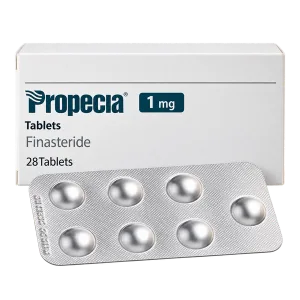
The first change I noticed was less hair on my pillow. I did not see a dramatic regrowth, but the thinning looked slower in photographs. I had no obvious side effects and decided the gradual result was worthwhile.
Finasteride tablets are used for adult men when DHT reduction is clinically appropriate. Results develop gradually, and continued treatment is needed to maintain the benefit.
About this product
Finasteride reduces the conversion of testosterone into dihydrotestosterone (DHT), a hormone linked with male-pattern hair loss and prostate enlargement. Finasteride belongs to the 5-alpha-reductase inhibitor class.
Pharmacological action
DHT binds to androgen receptors in susceptible tissues. In genetically predisposed hair follicles, ongoing DHT exposure can shorten the growth phase and gradually make hairs finer. Reducing DHT may slow this miniaturisation and help preserve existing hair follicles.
In the prostate, DHT supports the growth and maintenance of prostate tissue. Lowering DHT can reduce prostate volume and may improve urinary symptoms in men with BPH.
Finasteride differs from medicines that relax prostate muscle. Alpha-blockers can improve urinary flow by reducing smooth-muscle tone, while finasteride works by changing the hormonal stimulus that contributes to prostate enlargement. The two approaches may be used separately or together in suitable patients.
Finasteride also differs from testosterone-receptor blockers. It does not directly block androgen receptors. Instead, it reduces the formation of one active androgen, DHT.
A useful detail is that finasteride reduces serum and scalp DHT, yet it does not remove every androgen effect from the body. This explains why treatment can help DHT-sensitive tissues while leaving many testosterone-dependent functions unchanged. The European Medicines Agency recognises finasteride-containing medicines within this pharmacological class [2].
What it contains
The product is supplied as tablets.
The exact amount taken per intake is selected individually rather than being one fixed amount for every person. The appropriate strength depends on the condition being treated, treatment goals, age, and medical history.
The medicine can reduce DHT without lowering testosterone in the same way as hormone-suppressing treatments used for other conditions. Its action is targeted at the enzyme pathway responsible for DHT formation. The US Food and Drug Administration describes finasteride as a 5-alpha-reductase inhibitor in its prescribing information [1].
Directions for use
Finasteride tablets are taken by mouth. The amount per intake is set individually for each person rather than being one fixed number.
The prescribing plan normally specifies:
- The tablet strength.
- The number of tablets per intake.
- The frequency of administration.
- The intended treatment duration.
- Whether treatment is being used for hair loss or prostate symptoms.
Swallow the tablet with water. It may be taken with or without food unless the prescriber has given different instructions. Take it at approximately the same time each day to make missed doses less likely.
Do not crush, split, or chew a tablet unless the prescribed product specifically allows this. Finasteride can be absorbed through the skin from a broken or crushed tablet. Pregnant women, or women who may become pregnant, should not handle damaged tablets because exposure to finasteride may harm a male fetus.
If a dose is missed, take it when remembered unless the next scheduled dose is near. Do not double the next intake. An extra tablet does not accelerate hair growth or improve urinary symptoms.
Treatment duration depends on the indication. Hair-related benefit is assessed over months, not days. BPH treatment is often long term because prostate enlargement and urinary symptoms can return after treatment stops.
Reasons not to use it
Finasteride is not for you if you have a known allergy to finasteride or any tablet ingredient. It is also unsuitable for women who are pregnant or may become pregnant, and it is not indicated for children.
Specific situations requiring medical review include:
- Previous depression or suicidal thoughts.
- Existing sexual dysfunction.
- Difficulty conceiving or active fertility treatment.
- Liver disease, because finasteride is metabolised in the liver.
- Breast tenderness, enlargement, a lump, or nipple discharge.
- Plans for PSA testing or evaluation of prostate cancer risk.
- Use of several medicines for urinary symptoms or sexual function.
Finasteride should not be combined casually with another 5-alpha-reductase inhibitor. The combination does not provide a simple way to obtain faster results and may increase exposure to class-related adverse effects.
Current evidence does not identify a major routine interaction with most commonly prescribed medicines, yet the full medicine list still matters. Include prescription medicines, non-prescription products, vitamins, and herbal supplements when discussing treatment. The National Institute for Health and Care Excellence describes medicine review and PSA interpretation as important parts of care for men with lower urinary tract symptoms [4].
When this is not for you
Men with breast symptoms, unexplained blood in the urine, severe urinary retention, or repeated urinary infections need assessment rather than assuming that prostate enlargement is the only cause. Finasteride may be used in men with BPH, but it does not replace investigation of warning symptoms.
Adverse reactions
Finasteride is often tolerated without major problems, yet hormone-related adverse effects can occur. Reported reactions include:
- Reduced sexual desire.
- Difficulty achieving or maintaining an erection.
- Reduced amount of semen released during ejaculation.
- Breast tenderness or enlargement.
- Skin rash or itching.
- Mood changes, including depressed mood.
Sexual symptoms may begin during treatment and often improve after stopping, though persistent symptoms have been reported. The possibility should be discussed before treatment, especially when sexual function is already a concern.
Breast changes require attention. A new lump, pain, swelling, or nipple discharge needs medical assessment because breast symptoms have several possible causes. Do not assume that every breast change is a routine hormonal effect.
Mood symptoms deserve equal attention. New depression, marked loss of interest, or thoughts of self-harm require prompt clinical help. The MHRA and European regulatory authorities have reviewed psychiatric and sexual adverse-effect reports associated with finasteride-containing medicines.
A practical issue is PSA interpretation. Finasteride can lower PSA values, so the clinician interpreting a PSA test needs to know that finasteride is being used. A lower result may not represent the same cancer-screening risk as the same value in a man who is not taking a 5-alpha-reductase inhibitor.
Another detail is fertility. Finasteride may reduce ejaculate volume, and semen parameters can change in some men. Men trying to conceive should raise this before starting or continuing treatment, especially when fertility testing is already underway.
Side effects can be delayed. Feeling well during the first few weeks does not guarantee that sexual or mood-related effects cannot appear later.

Uses
Finasteride is used in two main clinical settings:
- Male-pattern hair loss, also called androgenetic alopecia.
- Benign prostatic hyperplasia (BPH), a non-cancerous enlargement of the prostate that can affect urinary flow.
These uses involve different treatment decisions. A dose suitable for hair loss is not automatically suitable for prostate symptoms.
Clinical response requires patience. Hair shedding may continue during the early treatment period because existing hairs still follow their natural growth cycle. Prostate symptoms also require time to improve, and prostate-specific antigen (PSA) results may be affected during treatment.
Comparison
The best option depends on whether the main goal is hair preservation, improved urinary flow, reduced prostate volume, or a combination of these outcomes.
| Approach | Main mechanism | Practical distinction |
|---|---|---|
| Finasteride | Reduces conversion of testosterone to DHT | Gradual hormonal treatment for DHT-sensitive hair follicles or prostate tissue |
| Dutasteride | Blocks more than one 5-alpha-reductase enzyme type | Produces broader DHT suppression and may have a longer-lasting effect after stopping |
| Alpha-blocker therapy | Relaxes smooth muscle in the prostate and bladder outlet | Can improve urinary flow sooner but does not reduce prostate size |
Dutasteride and finasteride are pharmacologically related but are not interchangeable without a prescribing decision. Dutasteride may remain in the body for a longer period, which can matter when adverse effects occur or treatment changes are planned.
Alpha-blockers can be useful when urinary symptoms require earlier relief. They may cause dizziness, postural blood-pressure changes, or ejaculation changes. Finasteride may be more suitable when prostate enlargement itself is a major part of the clinical problem.
For hair loss, treatment selection also depends on the pattern of thinning, the duration of hair loss, family history, and whether another scalp disorder is present. A receding hairline, diffuse thinning, and sudden patchy loss do not have identical causes.
The World Health Organization places finasteride within the urological medicines classification used for drugs affecting the prostate and related pathways [3].
Common mistakes
Several practical mistakes can make finasteride appear ineffective or increase avoidable risk:
- Expecting visible hair improvement within a few days.
- Taking extra tablets after a missed dose.
- Switching between hair-loss and prostate-treatment dosing without medical direction.
- Failing to mention finasteride before a PSA test.
- Handling crushed or broken tablets during pregnancy.
- Stopping after a short period because early shedding has not settled.
- Ignoring depression, suicidal thoughts, breast changes, or persistent sexual symptoms.
- Comparing hair photographs taken in different lighting.
- Assuming that a larger dose will produce faster hair growth.
- Starting another DHT-lowering medicine without reviewing the combination.
Early shedding can be emotionally difficult. It does not automatically prove treatment failure, but sudden severe shedding or scalp inflammation deserves assessment because other causes may be present.
Another common error is confusing symptom improvement with disease resolution. Better urinary flow does not prove that the prostate has returned to its previous size. Hair that looks fuller does not mean treatment can be stopped without a risk of gradual loss of the maintained benefit.
What doctors say
In clinical practice, physicians usually set expectations before treatment begins. Finasteride may preserve hair rather than restore every area of established baldness. A response in the crown area can differ from a response at the frontal hairline.
For BPH, doctors look at urinary symptoms, prostate size, PSA, kidney function, recurrent infections, and the possibility of urinary obstruction. Finasteride is not an instant relief tablet. Its value comes from reducing the hormonal driver of prostate growth over time.
A clinician may suggest photographs for hair treatment. The same lighting, angle, and hair length make gradual changes easier to judge. Daily mirror checks create false impressions because hair appearance changes with styling, washing, and light.
Physicians also ask about sexual function before starting. This makes later changes easier to recognise and prevents an important symptom from being overlooked. A man who develops reduced libido or erectile difficulty should not silently continue for months without discussing it.
Long-term treatment can be reasonable when benefits remain greater than adverse effects. The decision should be reviewed if symptoms change, PSA rises unexpectedly, pregnancy exposure is possible in the household, or a different diagnosis becomes likely. A PubMed-indexed review of finasteride therapy reports that benefit and tolerability require ongoing clinical assessment rather than a single early check.
Questions and answers
Can people under 18 use Finasteride?
Finasteride is not routinely indicated for children or adolescents under 18. The FDA and EMA describe its established uses in adult male patients, and paediatric treatment requires a separate specialist rationale. The tablet should not be used to manage teenage hair changes without identifying the cause. A clinician should assess sudden, patchy, inflammatory, or rapidly progressive hair loss. The 2025 FDA and EMA product information supports this restriction to appropriate adult use.
Can Finasteride be combined with other medicines or supplements?
Finasteride can be used alongside some medicines, but the complete list should be reviewed before treatment begins. The WHO and EMA classify it as a 5-alpha-reductase inhibitor, so combining it with another medicine from the same class may increase unnecessary exposure. Tell the prescriber about prostate medicines, hair-loss treatments, sexual-health medicines, vitamins, and herbal supplements. Do not add another DHT-lowering product independently. The 2025 FDA and EMA product information supports reviewing the full medicine list before combining treatments.
Which condition rules out Finasteride?
Pregnancy or possible pregnancy rules out exposure for women because finasteride can affect development of male fetal genitalia. The FDA and EMA identify this reproductive risk in their safety information, including the warning about damaged tablets. A known allergy to finasteride is another clear reason not to use it. Unexplained urinary retention, blood in the urine, or a breast lump also requires assessment before treatment rather than self-treatment. The 2025 FDA and EMA safety information supports medical review of these warning symptoms.
Can older adults use Finasteride?
Older men may use finasteride when BPH or another appropriate indication has been assessed. NICE and the WHO support age-specific review of urinary symptoms, prostate findings, PSA, kidney health, and concurrent medicines. Age alone does not determine suitability, but older adults often take more medicines and may have several causes of urinary symptoms. Finasteride may be useful for prostate enlargement while a separate assessment is needed for infection, obstruction, or malignancy. The 2025 NICE and WHO guidance supports evaluating these alternative causes separately.
What should be discussed with a doctor before starting Finasteride?
Discuss the treatment goal, previous sexual symptoms, fertility plans, mood history, liver disease, breast changes, and every medicine or supplement being used. The FDA and EMA recommend attention to sexual, psychiatric, reproductive, and breast-related safety information. Men who have had a PSA test should provide the previous result and explain any current or past use of finasteride. The treatment plan should also state how progress will be judged and when review is needed. The 2025 FDA and EMA safety information supports setting review points before treatment begins.
How long does a course of Finasteride last, and is long-term use acceptable?
Finasteride is commonly assessed over months, with treatment continuing when the benefit remains worthwhile and tolerability is acceptable. The FDA and NICE describe its use as ongoing therapy for appropriate adult indications rather than a short course designed to produce an immediate change. Hair benefits may gradually decline after stopping, while prostate symptoms may return as DHT activity and prostate growth resume. Stopping does not usually require a taper, but the decision should account for the original indication and any adverse effects. The 2025 FDA and NICE information supports reviewing the indication before long-term treatment is stopped.
Do you offer anonymous delivery?
Your order will be securely packed and shipped within 24 hours. This is exactly what your package will look like (images of an actual item sent). It has the size and look of a regular private letter (24x11x0.7 cm) and its contents cannot be seen.
Comparison
Sources
- U.S. Food and Drug Administration (2022). PROPECIA (finasteride) tablets, for oral use — prescribing information.
- European Medicines Agency (2017). Finasteride-containing medicinal products — product information.
- World Health Organization (2025). WHO Collaborating Centre for Drug Statistics Methodology: ATC/DDD Index — finasteride.
- National Institute for Health and Care Excellence (2024). Lower urinary tract symptoms in men: management.