The first month was harder than I expected. My lips cracked and my eyes felt dry with contact lenses, so I used glasses more often. By the third month, the deep jawline spots had reduced noticeably, but the blood tests and pregnancy precautions made the treatment feel very structured.
Accutane is used for severe nodular, cystic, scarring, or treatment-resistant acne. Its active ingredient, isotretinoin, reduces sebaceous-gland activity and inflammation through a monitored oral course. Treatment requires strict pregnancy prevention, blood-test follow-up, and careful management of dryness and other adverse effects.
About this product
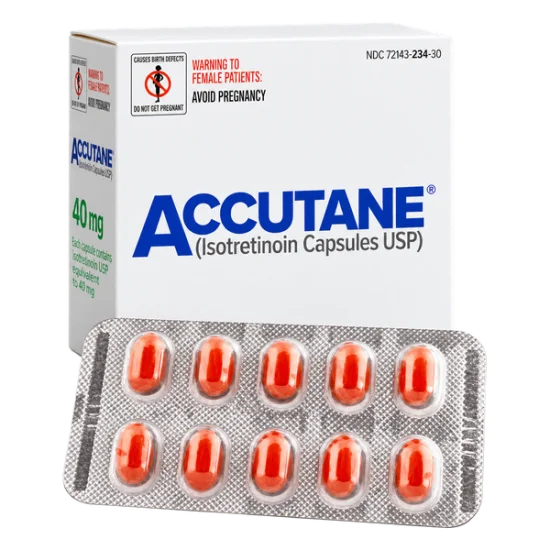
Accutane contains isotretinoin, an oral retinoid reserved for acne that has not responded adequately to standard treatment or carries a substantial risk of permanent scarring. Accutane is a systemic prescription course. It is taken as capsules and works throughout the body, unlike a cream or gel applied only to the skin.
Pharmacological action
Isotretinoin is related to vitamin A and changes the behaviour of skin cells inside the hair follicle. It reduces sebaceous-gland size and sebum production, making the skin less oily. Less oil can mean fewer blocked follicles and fewer conditions that support acne inflammation.
The same pharmacological action causes much of the expected dryness. Chapped lips, tight facial skin, dry eyes, and nasal irritation are common treatment experiences rather than signs that the medicine is working too strongly.
The FDA prescribing information describes isotretinoin as acting through several linked effects on sebaceous glands, follicular keratinisation, inflammation, and acne development [1].
Sebaceous-Gland Suppression
Sebaceous glands produce sebum, the oily substance that helps protect the skin. In severe acne, excess sebum combines with dead skin cells and creates a plug inside a follicle. Isotretinoin reduces this oil output, so fewer new comedones may form.
Improvement can continue after the capsules stop. A permanent cure cannot be promised, and some patients require another dermatologist-directed course.
Acne Inflammation and Follicular Blockage
Isotretinoin reduces the tendency of follicles to become blocked and lowers the inflammatory environment around acne lesions. It should not be described as a simple antibacterial treatment or as a scar-removal medicine. Existing deep scars often need separate dermatological assessment after active acne has settled.
What it contains
Accutane contains isotretinoin, an oral retinoid reserved for acne that has not responded adequately to standard treatment or carries a substantial risk of permanent scarring.
Directions for use
Isotretinoin dosing depends on body weight, acne severity, response, and tolerability. The prescriber may start with a lower dose, adjust it during follow-up, and consider the total exposure across the course. A typical course lasts about four to six months, though some patients need a different schedule.
The dose wording for Accutane is clinician-directed: how much to use and how often depends on the purpose of treatment and is agreed with a doctor or pharmacist.
Weight-Based Dosing and Cumulative Exposure
Dermatologists may consider cumulative exposure, meaning the total amount taken over the full course relative to body weight. This helps guide treatment duration but is not a self-calculation tool. Blood results, dryness, mood symptoms, acne response, and other adverse effects can lead to dose changes.
- Take capsules only as prescribed.
- Swallow them using the product-specific administration instructions.
- Never share capsules.
- Do not use leftover capsules from an earlier course.
- Do not double the next dose after a missed dose.
- Keep every scheduled clinical review and laboratory appointment.
Some isotretinoin formulations have food-related absorption instructions. Follow the prescriber’s directions for the specific capsules supplied rather than applying advice from a different formulation.
Four-to-Six-Month Treatment Timeline
Early dryness may appear before visible acne improvement. Some patients experience an initial worsening, followed by gradual reduction in new inflammatory lesions. The final result depends on dose exposure, acne severity, adherence, and tolerability.
Reasons not to use it
Isotretinoin is a potent teratogen. Pregnancy must be excluded before treatment and reliably prevented during treatment and for the required period after treatment. The exact timing and testing schedule are set by the prescriber and local reproductive-safety requirements.
Do not combine isotretinoin with tetracycline antibiotics unless a specialist has specifically reviewed the combination. The combination can increase the risk of raised intracranial pressure.
Vitamin A supplements should also be avoided unless the prescriber has specifically authorised them. Isotretinoin is related to vitamin A, and additional intake may increase toxicity.
Accutane is not suitable for someone with a known serious allergy to isotretinoin or its capsule ingredients. The treating clinician also needs to know about liver disease, high triglycerides, pancreatitis history, significant psychiatric symptoms, inflammatory bowel disease concerns, and current medicines.
The EMA has issued pregnancy-prevention measures for oral retinoids because fetal exposure can cause severe birth defects and pregnancy loss [2].
When this is not for you
Accutane is not suitable during pregnancy. It must not be used by anyone who is pregnant, planning pregnancy during the restricted period, or unable to meet the prescriber’s pregnancy-prevention requirements.
Breastfeeding also requires a specific clinical decision because isotretinoin may pass into breast milk and could harm an infant. The treatment plan must address pregnancy testing, contraception, and breastfeeding before capsules are started.
A missed period or possible pregnancy requires immediate contact with the treating clinician. Do not wait for acne improvement before continuing the agreed pregnancy-prevention measures.
Adverse reactions
Dry lips are extremely common. Dry or irritated facial skin, dry eyes, nasal dryness, nosebleeds, sun sensitivity, muscle aches, and joint discomfort can also occur. The severity differs from person to person and may change after a dose adjustment.
| Symptom | Practical care | Medical review |
|---|---|---|
| Dry lips or skin | Use bland moisturising products and avoid harsh scrubs | Severe cracking, bleeding, or spreading rash |
| Dry eyes or contact-lens discomfort | Reduce lens wear and consider preservative-free artificial tears | Persistent eye pain or visual change |
| Nose dryness or nosebleeds | Use gentle nasal moisturising care and avoid picking | Frequent, prolonged, or heavy bleeding |
Carry lip balm with you. Waiting until the lips are already split makes daily care harder.
Sun sensitivity can increase. Use shade, protective clothing, and broad-spectrum sunscreen. Avoid waxing, aggressive exfoliation, and certain resurfacing procedures unless the dermatologist has reviewed the timing.
Contact-lens wearers may notice that lenses become uncomfortable. Tell the prescriber about persistent irritation rather than simply switching to a stronger eye drop. Muscle or joint pain also deserves review when it is severe, persistent, or limiting normal activity.
Uses
Accutane contains isotretinoin, an oral retinoid reserved for acne that has not responded adequately to standard treatment or carries a substantial risk of permanent scarring. Dermatologists may consider it for severe nodular acne, cystic pimples, widespread inflammatory lesions, or persistent acne that significantly affects daily life.
A nodule is a deep, firm, painful inflammatory lesion. A cyst is also deep but may feel softer and contain inflammatory fluid. Both can damage collagen and leave depressed or raised scars. Hormonal acne may have jawline or cyclical features, yet hormonal pattern alone does not automatically justify isotretinoin.
Clinical Indications for Isotretinoin
A dermatologist usually reviews:
- Acne severity and the presence of nodules, cysts, or scarring
- Previous treatment with topical and oral therapies
- Liver health and blood-lipid history
- Current medicines and supplements
- Pregnancy possibility and contraception requirements
- Mood history and neurological symptoms
The goal is not simply to clear today’s lesions. The prescriber weighs the risk of scarring against the monitoring burden and reproductive risks of isotretinoin.
Cystic and Hormonal Acne Patterns
Severe acne with hormonal features can improve during an isotretinoin course because the medicine reduces oil production and follicular blockage. It does not correct every underlying hormonal disorder. Acne may return after treatment, especially when the original drivers remain active.
Comparison
The choice depends on acne severity, scarring risk, previous treatment, pregnancy potential, and the need for systemic monitoring. Oral isotretinoin is not interchangeable with topical retinoids.
| Treatment approach | Typical role and main limitation |
|---|---|
| Oral isotretinoin | Severe, nodular, cystic, scarring, or treatment-resistant acne; requires reproductive precautions and laboratory follow-up |
| Topical tretinoin or adapalene | Mild-to-moderate acne or maintenance; can irritate skin and may be insufficient for deep nodules |
| Topical dapsone or niacinamide | Selected inflammatory acne or supportive care; usually does not replace systemic treatment for severe cystic disease |
Tretinoin and adapalene act within the skin and may help prevent follicular blockage. They can be useful when systemic therapy is unnecessary or after an isotretinoin course as part of maintenance. Dapsone may help selected inflammatory lesions, while niacinamide is generally used as a supportive topical ingredient.
The National Institute for Health and Care Excellence recommends matching acne treatment to severity, scarring risk, and patient factors rather than using one treatment for every presentation [3]. The American Academy of Dermatology also supports selecting treatment according to acne severity and patient-specific risks.
Common mistakes
Several practical errors repeatedly create problems during isotretinoin courses:
- Doubling the next dose after a missed capsule
- Changing the dose because acne flares briefly
- Sharing capsules with a family member
- Stopping pregnancy prevention when the skin begins to clear
- Taking tetracycline antibiotics without checking the interaction
- Adding vitamin A supplements
- Using strong scrubs, peels, or abrasive brushes on dry skin
- Ignoring depression, suicidal thoughts, or major behaviour changes
- Treating persistent eye pain or visual symptoms as ordinary dryness
- Assuming a second course is appropriate without a new assessment
Check every newly prescribed medicine for tetracycline content. Common medicine names can be overlooked when the patient remembers only the brand or treatment purpose.
Alcohol intake should be reviewed individually, especially when liver enzymes or triglycerides are abnormal. A universal alcohol rule is less useful than a medication and health-history review.
What doctors say
Dermatologists often view isotretinoin as a treatment trade-off. It can produce a major reduction in severe inflammatory acne and may reduce the ongoing risk of new scars, yet the course requires strict reproductive precautions, blood-test follow-up, and active monitoring of mood and physical symptoms.
A clinician usually wants realistic expectations: the first weeks may be uncomfortable, the skin may become very dry, and the final response is not judged from a single bad day. Dose changes are based on the whole picture, including acne activity, laboratory results, dryness, headaches, mood, and treatment adherence.
The benefit is strongest when the treatment plan is followed consistently. The limitation is equally clear: isotretinoin is not appropriate for every patient with acne, and relapse remains possible after the course.
Questions and answers
Can Accutane affect driving, concentration, or work with machinery?
Accutane may cause visual symptoms, severe headache, dizziness, unusual tiredness, or mood changes that can make driving or machinery work unsafe. The FDA prescribing information available in 2024 supports prompt assessment of significant visual or neurological symptoms. Do not drive or operate machinery when vision is blurred, concentration is impaired, or a severe headache is present.
How soon does Accutane’s effect become noticeable?
Some people notice reduced oiliness or fewer new lesions after several weeks, while deeper acne may take longer to improve. NICE guidance in 2023 describes acne treatment as a staged process, and early worsening can occur with isotretinoin. A lack of dramatic improvement during the first few weeks does not justify doubling the dose or stopping pregnancy precautions.
Can Accutane be used during pregnancy or breastfeeding?
Accutane should not be used during pregnancy. Isotretinoin is a potent teratogen, and pregnancy must be excluded before treatment and reliably prevented during treatment and for the required period afterward. EMA reproductive-safety measures reaffirmed in 2018 also require careful attention to pregnancy testing and contraception. Breastfeeding requires a separate clinical decision because isotretinoin may expose the infant through breast milk.
Is Accutane suitable for older adults?
Age alone does not decide suitability, but older adults may have more medical conditions and take more medicines that affect prescribing decisions. A dermatologist may review liver function, triglycerides, cholesterol, cardiovascular risk, diabetes, bone or joint symptoms, and mood history before treatment. The WHO’s 2022 guidance on medication safety supports reviewing the full medicine list and health history in people with multiple conditions.
What should happen if the expected result does not come?
Do not increase the dose, extend the course, or use leftover capsules independently. The dermatologist may review adherence, cumulative exposure, acne type, laboratory results, interactions, and whether another diagnosis or treatment approach needs consideration. NICE acne guidance from 2023 supports reassessment when acne remains severe, scarring continues, or treatment is poorly tolerated.
How long does an Accutane course last, and is long-term use acceptable?
A typical isotretinoin course lasts around four to six months, but the duration depends on response, weight-based dosing, cumulative exposure, and adverse effects. Long-term continuous use is not a routine self-directed option because isotretinoin requires ongoing safety assessment. FDA prescribing information from 2024 supports prescriber-led dose changes, monitoring, and decisions about whether another course is appropriate.
Do you offer anonymous delivery?
Your order will be securely packed and shipped within 24 hours. This is exactly what your package will look like (images of an actual item sent). It has the size and look of a regular private letter (24x11x0.7 cm) and its contents cannot be seen.
Comparison
Accutane Current
Diane 35
Sources
- U.S. Food and Drug Administration (2002). Accutane (isotretinoin) Prescribing Information.
- European Medicines Agency (2018). Updated measures for pregnancy prevention during retinoid use.
- National Institute for Health and Care Excellence (2023). Acne vulgaris: management (NG198).