Skip to content
Cosopt
Active ingredient: Dorzolamide, Timolol

Cosopt

Quality products
24/7 Support
Fast delivery
Delivery from 4 days
Select pack Package Per unit Price

Free delivery on orders from AED 796.00, free express delivery from AED 1,194.00

Secure Payments
Track your order
Best price guarantee

Dorzolamide hydrochloride and timolol maleate, the active ingredients of Cosopt, combine carbonic anhydrase inhibition with beta-blockade to lower pressure inside the eye. Cosopt is prescribed for adults with open-angle glaucoma or ocular hypertension when reducing aqueous-fluid production helps protect the optic nerve and preserve vision.

About this product

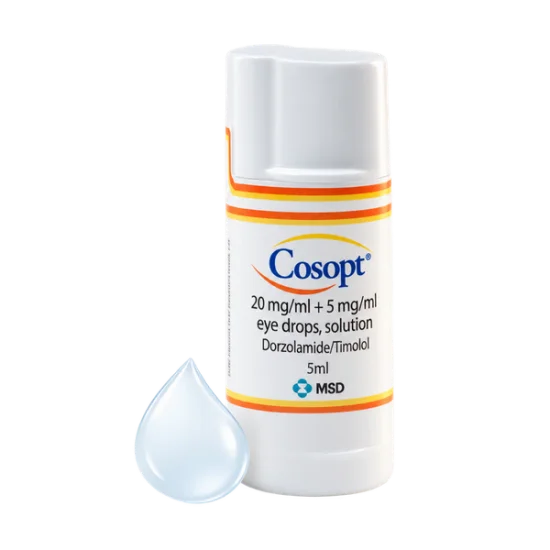
Cosopt is a prescription ophthalmic solution supplied in a bottle for application as eye drops. It contains dorzolamide hydrochloride and timolol maleate. Dosing differs between strengths and between users, so there is no single amount that suits everyone. The combination is used when intraocular pressure remains above the desired range in open-angle glaucoma or ocular hypertension.

Pharmacological action

Dorzolamide inhibits carbonic anhydrase II in the ciliary processes of the eye, reducing bicarbonate formation and aqueous-fluid secretion. Timolol is a non-selective beta-adrenergic receptor blocker that reduces stimulation of the ciliary body and aqueous-humour production. Together, the two mechanisms lower intraocular pressure through complementary pathways.

What it contains

Cosopt contains two active substances that reduce aqueous-humour production through different pathways. Aqueous humour is the clear fluid produced inside the eye; excessive production or impaired drainage can raise intraocular pressure.

Active substance Drug class and main action
Dorzolamide hydrochloride Carbonic anhydrase inhibitor that reduces bicarbonate formation and aqueous-humour secretion
Timolol maleate Ophthalmic beta-blocker that reduces aqueous-humour production through beta-adrenergic blockade

The combined action can produce greater pressure reduction than either mechanism alone. The effect concerns intraocular pressure, not general eye lubrication.

Role of dorzolamide hydrochloride

Dorzolamide inhibits carbonic anhydrase II in the ciliary processes of the eye. This enzyme contributes to bicarbonate formation, which supports movement of sodium and fluid into the aqueous humour. Inhibition reduces aqueous-fluid secretion and lowers intraocular pressure.

Dorzolamide may cause temporary stinging, blurred vision, or a bitter taste after installation. The bitter taste occurs when a small amount of solution drains through the tear duct into the throat. Nasolacrimal occlusion, using gentle pressure at the inner eye corner, can reduce this systemic passage.

Role of timolol maleate

Timolol is a non-selective beta-adrenergic receptor blocker. In the eye, it reduces stimulation of the ciliary body and lowers aqueous-humour production. Although applied topically, some timolol can enter the bloodstream through the conjunctiva and nasal mucosa.

This systemic absorption explains why people with asthma, severe chronic obstructive pulmonary disease, slow heart rate, certain conduction disorders, or overt cardiac failure require specific assessment before treatment. The FDA prescribing information describes these risks for ophthalmic timolol-containing products [2].

Do not squeeze the eyelids tightly after using Cosopt. Firm squeezing can push fluid into the tear duct and increase systemic absorption, while gentle closure gives better control.

A contact lens can absorb preservatives in some ophthalmic solutions and may become uncomfortable. Contact-lens wearers should discuss lens removal and replacement timing with the prescribing clinician.

Directions for use

Cosopt is administered by placing the prescribed number of drops into the affected eye or eyes. Dosing differs between strengths and between users, so there is no single amount that suits everyone.

  • Use the prescribed dose at the prescribed times.
  • Wash and dry the hands before ocular administration.
  • Keep the bottle tip away from the eye, eyelashes, fingers, and other surfaces.
  • Apply other eye drops separately, usually with an interval of at least five minutes unless the prescriber gives a different instruction.
  • Close the eye gently after the drop is applied.
  • Press the inner corner of the closed eye for approximately one minute.
  • Do not place extra drops in the eye to compensate for spillage.
  • If a dose is missed, use it when remembered unless the next scheduled dose is near; do not double the next application.

Cosopt is generally used as a continuing pressure-control treatment rather than as a short course. Stopping treatment without an alternative plan can allow intraocular pressure to rise again. The European Medicines Agency product information describes combination therapy and administration principles for dorzolamide and timolol ophthalmic treatment [3].

A practical way to avoid contamination is to rest the hand holding the bottle on the forehead while the other hand gently pulls down the lower eyelid. The tip still must remain clear of the eye surface.

If the bottle tip touches the eye, eyelid, or lashes, continued use may introduce microorganisms into the solution. Eye pain, marked redness, discharge, or a sudden change in vision requires prompt clinical assessment.

Reasons not to use it

Specific situations requiring avoidance or careful medical review include:

  • Bronchial asthma or a history of severe asthma
  • Severe chronic obstructive airway disease with bronchospasm
  • Sinus bradycardia or second- or third-degree atrioventricular block without a functioning pacemaker
  • Overt cardiac failure or cardiogenic shock
  • Severe renal impairment or significant kidney disease
  • Previous serious reaction to a sulfonamide-related medicine
  • Planned eye surgery or recent ocular trauma
  • Pregnancy or breastfeeding, where the potential benefit and risk need individual assessment

Timolol can add to the effect of oral beta-blockers, some calcium-channel blockers, antiarrhythmics, digitalis-related medicines, and medicines that slow the heart. Combining it with other pressure-lowering eye drops may produce an excessive fall in intraocular pressure. Carbonic anhydrase inhibitors taken by mouth can increase the total carbonic anhydrase-inhibitor exposure.

People using clonidine, quinidine, fluoxetine, paroxetine, or other medicines that influence beta-blockade should provide a complete medication list before treatment. The WHO guidance on glaucoma care emphasises matching pressure-lowering treatment to ocular findings and systemic health [4].

When this is not for you

Cosopt may not be right for you if you have asthma or serious breathing problems, a slow pulse, heart-conduction problems, heart failure, significant kidney disease, or a serious reaction to sulfonamide-related medicines. Tell your clinician about pregnancy or breastfeeding, planned eye surgery, recent eye injury, and all medicines or eye drops you use before starting treatment.

Adverse reactions

The most common reactions are local and short-lived. They can include burning, stinging, tearing, blurred vision immediately after application, itching, redness, dry eyes, or a bitter taste. These effects may improve as the eye adapts, but persistent irritation should be assessed.

Potential systemic effects relate mainly to timolol absorption. They may include a slow pulse, dizziness, fatigue, shortness of breath, wheezing, cold hands, or reduced exercise tolerance. Dorzolamide can cause taste disturbance and, rarely, hypersensitivity reactions or symptoms associated with sulfonamide-related sensitivity.

Seek urgent medical attention for:

  • Wheezing or difficulty breathing
  • Fainting or severe dizziness
  • New chest discomfort
  • Markedly slow or irregular heartbeat
  • Swelling of the face, lips, tongue, or throat
  • Severe eye pain or sudden visual deterioration
  • Extensive rash or blistering skin reaction

A temporary blur immediately after a drop can affect driving. Wait until vision is clear before driving or operating machinery.

The bitter taste from dorzolamide is often less noticeable when the inner eye corner is pressed gently after application. This small technique also limits the amount reaching the nose and throat.

Preservatives may worsen discomfort in people with dry eye or frequent long-term drop use. A clinician may consider a different formulation if surface irritation becomes persistent.

Uses

Cosopt is used in adults for:

  • Open-angle glaucoma
  • Ocular hypertension
  • Inadequate pressure control with a single eye-pressure-lowering medicine
  • Situations where two complementary mechanisms are clinically appropriate

The treatment does not restore optic-nerve tissue already lost through glaucoma. Its role is pressure control and prevention of further damage. Regular eye examinations remain necessary because eye pressure, optic-nerve appearance, and visual fields can change independently.

Eye drops work best when the drop reaches the eye rather than the cheek. Close the eyelids gently after application and press the inner corner of the eye for about one minute to reduce drainage into the nose.

Cosopt is not an oral tablet or an injectable treatment. The bottle contains a sterile solution intended for ocular use.

Lowering intraocular pressure reduces a major risk factor for progressive visual-field loss [1].

Comparison

Cosopt differs from single-agent treatment because it combines two mechanisms in one ophthalmic solution. A clinician may choose a single carbonic anhydrase inhibitor, a single beta-blocker, a prostaglandin-based treatment, laser therapy, or surgery according to pressure level, optic-nerve findings, medical history, and response.

Treatment approach Main pharmacological distinction
Cosopt combination drops Carbonic anhydrase inhibition plus beta-blockade; reduces aqueous-fluid production through two pathways
Single carbonic anhydrase inhibitor Uses one aqueous-production pathway and may be considered when beta-blockade is unsuitable
Prostaglandin-based eye treatment Primarily increases uveoscleral outflow rather than combining two production-suppressing mechanisms

A combination product can reduce the number of separate bottles and simplify a regimen. Its limitation is that both active substances are delivered together, so it may be unsuitable when a patient cannot use either dorzolamide or timolol.

Prostaglandin-based therapy is often considered when once-daily administration or a different mechanism is preferred, while beta-blocker-containing treatment needs greater care in people with respiratory or cardiovascular disease. The choice is clinical rather than a matter of one approach being universally superior.

Common mistakes

Several practical errors can reduce the effect of Cosopt or increase unwanted exposure:

  • Applying two or three drops when one prescribed drop spills
  • Touching the bottle tip against the eye or lashes
  • Skipping doses because glaucoma causes no symptoms
  • Using Cosopt immediately after another eye drop without an interval
  • Forgetting to mention asthma, slow pulse, or heart-conduction disease
  • Continuing contact lenses during application when the formulation or clinician instructions require removal
  • Stopping suddenly after a pressure reading improves
  • Using a missed dose together with the next dose
  • Driving before temporary post-application blurring has cleared

One overlooked issue is the order of multiple eye treatments. If a thick gel or ointment is used, it is generally applied after liquid drops unless the prescriber gives another sequence. A short interval between liquid products prevents the second drop from washing out the first.

Keep a simple dosing record if several eye medicines are prescribed. Marking each administration immediately can prevent both missed doses and accidental double dosing.

Another common mistake is judging treatment by redness alone. Pressure may remain elevated without visible redness, and a comfortable eye may still require continued monitoring.

What doctors say

In clinical practice, ophthalmologists usually judge Cosopt by the pressure achieved, the stability of the optic nerve, and the patient’s visual-field results rather than by symptom relief. Glaucoma often progresses silently, so feeling comfortable does not prove that pressure is controlled.

A physician will usually ask about asthma, wheezing, pulse rate, fainting, heart disease, kidney function, allergies, and current eye treatments. The answer may change the preferred drug class. A patient with excellent pressure reduction but recurrent wheezing has a clinically poor treatment balance.

The American Academy of Ophthalmology describes medication adherence, pressure monitoring, optic-nerve assessment, and visual-field testing as central elements of glaucoma care. Treatment success is measured over time, not by how the eye feels on a single day.

Questions and answers

How does Cosopt differ from a single pressure-lowering eye drop?

Cosopt combines dorzolamide hydrochloride and timolol maleate, while a single-agent product uses one pharmacological mechanism. Dorzolamide reduces aqueous-humour production through carbonic anhydrase inhibition, and timolol reduces production through beta-adrenergic blockade. The FDA product label from 2023 describes these complementary actions and the need to consider systemic beta-blocker effects.

Which condition rules out Cosopt most clearly?

A history of asthma with bronchospasm is a major reason Cosopt may be unsuitable because timolol can worsen airway narrowing after systemic absorption. Severe chronic obstructive pulmonary disease, marked bradycardia, advanced heart block, and overt cardiac failure also require avoidance or specialist review. EMA product information from 2024 lists these cardiovascular and respiratory contraindications for ophthalmic timolol combinations.

What should be discussed with a doctor before starting Cosopt?

Discuss asthma, breathing symptoms, pulse rate, fainting, heart disease, kidney problems, sulfonamide reactions, pregnancy, breastfeeding, planned eye surgery, and every medicine or eye drop being used. Tell the clinician if contact lenses are worn or if the eyes are already very dry. The FDA prescribing information from 2023 supports reviewing relevant medical history and concurrent treatment before starting therapy.

What should be done after a missed dose?

Apply the missed dose when remembered unless the next scheduled dose is close. In that situation, skip the missed application and return to the normal schedule. Do not apply extra drops to compensate, because excess solution increases exposure without producing a proportional pressure benefit. The FDA prescribing information from 2023 supports avoiding dose doubling after a missed ophthalmic application.

Can Cosopt affect driving, concentration, or machinery work?

Temporary blurred vision, stinging, tearing, dizziness, fatigue, or a slow pulse can affect driving and machinery work. Wait until vision is clear and you feel steady before starting these activities. The European Medicines Agency product information from 2024 recognises transient visual disturbance and possible systemic beta-blocker effects after ophthalmic use.

How long does one application keep working?

Cosopt is designed for repeated administration across the day, with the exact schedule determined by the prescriber. The pressure-lowering effect is maintained through regular dosing rather than by applying extra drops when pressure is suspected to be high. Ophthalmic beta-blocker and carbonic anhydrase-inhibitor combinations are assessed through pressure measurements over time, as described in European Medicines Agency information from 2024.

Is Cosopt suitable for older adults?

Older adults may use Cosopt when the ophthalmologist considers the benefits appropriate, but pulse rate, cardiovascular disease, kidney function, dexterity, vision, and the full medicine list deserve careful review. Difficulty opening a bottle or placing a drop accurately can affect treatment success. WHO glaucoma guidance published in 2019 supports individualising treatment according to eye findings, general health, and the person’s ability to follow the regimen.

Do you offer anonymous delivery?

Your order will be securely packed and shipped within 24 hours. This is exactly what your package will look like (images of an actual item sent). It has the size and look of a regular private letter (24x11x0.7 cm) and its contents cannot be seen.

Sources

  1. European Medicines Agency (2024). Summary of Product Characteristics for dorzolamide/timolol ophthalmic solution.
  2. U.S. Food and Drug Administration (2023). COSOPT (dorzolamide hydrochloride-timolol maleate) ophthalmic solution prescribing information.
  3. European Medicines Agency (2023). Dorzolamide/timolol ophthalmic product information.
  4. World Health Organization (2019). World report on vision.

Cosopt: What Customers Say

3.3
Based on 3 reviews
Faisal K., 28 Ajman Several weeks
Verified
Rating: 4 out of 5

The first few applications stung and my vision was blurry for a short time. Pressing the inner corner helped with the bitter taste, and the drops became easier to use after that.

27 Oct 2026
Mohammed, 42 Ras Al Khaimah About two months
Verified
Rating: 3 out of 5

My pressure checks improved, but I noticed tiredness and a slower pulse during exercise. The ophthalmologist reviewed my heart medicines and changed the plan rather than telling me to continue through it.

1 Oct 2026
Imran, 58 Khor Fakkan
Verified
Rating: 3 out of 5

The main difficulty was remembering which bottle came first. Leaving several minutes between drops made the routine clearer, although the temporary blur meant I had to wait before driving.

15 Oct 2026
Get our free app Shop faster and track your orders Install