The first applications felt hot for about half an hour. By the end of the first week, the itching around my cheeks had eased, and I was able to sleep better.
Tacrolimus, the active ingredient of Protopic, is a topical calcineurin inhibitor for inflammatory skin disease. Protopic 0.1% ointment is used in adults and selected adolescents with atopic dermatitis when targeted immune control is needed. It reduces inflammatory signalling, itching, and redness without the skin-thinning mechanism associated with topical corticosteroids.
About this product
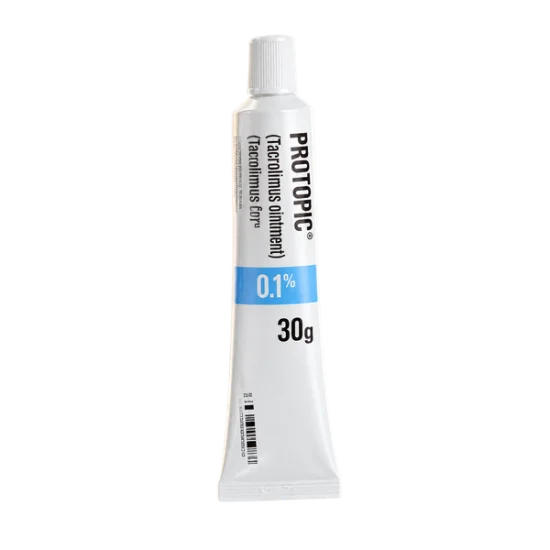
Protopic is a tacrolimus ointment supplied in a tube. The product contains tacrolimus at a concentration of 0.1%, with tacrolimus functioning as a topical immunosuppressant and calcineurin inhibitor. The ointment is applied directly to affected skin rather than taken by mouth.
Pharmacological action
Tacrolimus reduces the activity of T lymphocytes, immune cells that release inflammatory signals during atopic dermatitis. By limiting calcineurin-dependent cytokine production, it helps calm redness, itching, and recurrent eczema inflammation. The medicine acts locally in the skin and does not work through the same pathway as a corticosteroid. [1]
Mechanism of immune response modulation
Calcineurin is an enzyme involved in activating T-cell inflammatory responses. Tacrolimus inhibits this pathway inside immune cells, reducing the release of cytokines involved in eczema inflammation.
This mechanism explains why Protopic is useful when repeated steroid exposure is undesirable, such as on the face, eyelids, neck, or skin folds. A burning or warm sensation can occur during the first applications because inflamed skin is highly reactive.
What it contains
Active ingredient and ointment formulation
The active pharmaceutical ingredient is tacrolimus. The product form is a 0.1% topical ointment in a 30 g tube.
The ointment base helps tacrolimus remain in contact with the affected epidermis. It should be used only on areas identified for treatment. Applying a thicker layer does not improve the immune effect and can increase local discomfort.
Directions for use
How much Protopic to use and how often depends on the purpose of treatment and is agreed with a doctor or pharmacist. Use it only on affected skin and follow the prescribed schedule.
- Apply a thin layer to the affected area.
- Avoid applying it to infected skin unless the infection has been assessed and managed.
- Keep the ointment away from the eyes and mucous membranes.
- Wash hands after application unless the hands are part of the treatment area.
- If a scheduled application is missed, apply it when remembered if it is still reasonably close to the planned time; do not apply extra ointment to compensate.
- Do not cover treated skin with airtight dressings unless specifically instructed.
- Avoid bathing, showering, or swimming immediately after application because water can remove the ointment from the skin.
Sun protection matters during treatment. Limit unnecessary exposure to natural sunlight and avoid tanning equipment, because tacrolimus-treated skin should not receive avoidable ultraviolet exposure.
One practical mistake is applying Protopic to every dry patch. Dryness alone may respond to an emollient, while tacrolimus is intended for diagnosed inflammatory eczema. Another is using a large amount because the skin feels tight; more ointment does not make tacrolimus work faster.
Reasons not to use it
This treatment is not for you if you have a known allergy to tacrolimus, any ingredient in the ointment, or a previous serious reaction to a macrolide-type medicine. It is also unsuitable for untreated infected eczema, active viral lesions at the application site, or certain severe skin disorders unless a dermatologist has made a specific plan.
Use requires extra care in the following situations:
- suspected bacterial, viral, or fungal infection on the treatment area;
- enlarged lymph nodes without an established explanation;
- a weakened immune system;
- extensive skin disease;
- treatment with medicines that strongly inhibit CYP3A4, including some macrolide antibiotics, azole antifungals, and certain HIV medicines;
- pregnancy or breastfeeding;
- regular exposure to ultraviolet treatment or intense sunlight.
Tacrolimus ointment has limited systemic absorption when used correctly on restricted areas, but absorption can rise when large body areas, damaged skin, or occlusive dressings are involved. The prescribing clinician should know about immune-suppressing medicines, cancer treatment, transplant medicines, and medicines that affect tacrolimus metabolism.
Alcohol is not a pharmacological treatment interaction in the same way as a CYP3A4 inhibitor, but it may trigger flushing or warmth around treated facial skin. That reaction can be uncomfortable and may be mistaken for a sudden eczema deterioration. [2]
When this is not for you
This treatment is not for you if you have a known allergy to tacrolimus, any ingredient in the ointment, or a previous serious reaction to a macrolide-type medicine. It is also unsuitable for untreated infected eczema, active viral lesions at the application site, or certain severe skin disorders unless a dermatologist has made a specific plan.
Adverse reactions
The most frequent early reactions are burning, warmth, itching, redness, or stinging where the ointment is applied. These effects often appear during the first days of treatment and may become less troublesome as the skin settles. Alcohol can produce facial flushing or a hot sensation in some people using topical tacrolimus.
Other possible reactions include folliculitis, acne-like changes, cold sores, herpes infections, swollen hair follicles, and increased sensitivity at the application site. The risk can be more relevant when large areas are treated or when the skin barrier is severely damaged.
Seek prompt medical assessment for spreading redness, pus, severe pain, extensive blistering, facial swelling, breathing difficulty, or signs of a serious allergic reaction. Protopic should be paused on skin with a suspected active infection until the infection has been evaluated.
One detail patients often miss is the relationship between heat and discomfort. Hot showers, vigorous exercise, fever, or warm weather may make burning more noticeable shortly after application.
Uses
Protopic 0.1% ointment is used for atopic dermatitis, also called atopic eczema, in patients for whom topical corticosteroids are unsuitable, insufficient, or inappropriate for longer-term management. A dermatologist may also select it for recurring inflammation in sensitive areas where preserving skin thickness is a priority.
| Skin condition | Treatment objective | Practical role |
|---|---|---|
| Atopic dermatitis | Reduce inflammatory redness and itching | Treatment of active affected areas |
| Atopic eczema | Calm recurrent local inflammation | Steroid-sparing topical option |
| Sensitive-area eczema | Control inflammation while limiting steroid exposure | Often considered for facial or flexural skin |
Management of atopic dermatitis flare-ups
Atopic dermatitis can produce dry patches, itching, scaling, redness, and periods of worsening inflammation. Protopic targets the immune activity responsible for the flare rather than acting as a moisturiser. Emollients remain useful for dryness, but they serve a different purpose from tacrolimus ointment.
The treatment area should be free from active bacterial, viral, or fungal infection before application. Crusting, spreading warmth, pus, grouped blisters, or rapidly worsening pain can signal infection and require medical assessment before continuing anti-inflammatory treatment.
Therapeutic role in eczema control
Protopic may be chosen for eczema affecting areas where prolonged corticosteroid use can be difficult to manage. These areas include the eyelids, face, neck, and skin folds. The absence of corticosteroid activity means it does not cause skin thinning through the same mechanism, although it can still cause irritation and requires careful use.
Patients often expect the itching to disappear immediately. That is not a reliable measure of treatment response. Inflammation may begin settling before the skin texture and itch sensitivity return to normal.
Comparison
Protopic belongs to the topical calcineurin inhibitor class. Topical corticosteroids are another major anti-inflammatory group used for atopic dermatitis. The choice depends on body site, severity, treatment history, age, infection status, and the condition of the skin.
| Approach | Main pharmacological action | Main limitation |
|---|---|---|
| Protopic, topical calcineurin inhibitor | Suppresses T-cell inflammatory signalling | Burning or warmth may occur initially |
| Topical corticosteroid | Reduces several inflammatory pathways | Repeated prolonged use can contribute to skin atrophy |
| Emollient therapy | Restores hydration and supports the skin barrier | Does not directly suppress active immune inflammation |
Calcineurin inhibitors versus topical corticosteroids
Topical corticosteroids can reduce eczema inflammation quickly and remain useful for many flares. Their limitations include potency-related risks, especially when strong products are used repeatedly on thin skin or under occlusion. Skin atrophy, visible small blood vessels, and steroid-related changes are concerns with inappropriate long-term exposure.
Protopic does not produce skin thinning through corticosteroid activity. It can be useful on areas where that concern carries greater weight. Its drawbacks include application-site burning, sensitivity to heat or sunlight, and a slower improvement in some flares compared with a suitable corticosteroid.
The two approaches are not interchangeable. A clinician may use a corticosteroid for a short acute flare and Protopic for a steroid-sparing plan, depending on the diagnosis and body site.
Common mistakes
Several practical errors can reduce the benefit of Protopic:
- applying it to a rash that has not been diagnosed as eczema;
- using it on visibly infected skin;
- spreading it over unaffected skin;
- applying a thick layer instead of a thin film;
- stopping after the first uncomfortable application without discussing persistent irritation;
- placing a tight dressing over the area;
- exposing treated skin to tanning equipment;
- applying it while the skin is wet;
- using it at the same time as multiple irritating cosmetics;
- assuming a moisturiser and tacrolimus ointment have the same function.
A further mistake is judging the treatment after one application. Atopic dermatitis is an inflammatory skin condition, and improvement may develop over several applications rather than within minutes. Persistent worsening, new infection signs, or a rash that changes character should prompt a clinical review.
What doctors say
In clinical practice, dermatologists usually set expectations before treatment begins. Protopic is designed to reduce eczema inflammation; it does not permanently remove the underlying tendency toward atopic dermatitis. Relapses can still occur when irritants, infection, climate, sweating, stress, or barrier damage trigger the skin. The treatment goal is control rather than permanent elimination. Follow-up helps distinguish a flare from infection or another diagnosis.
A physician will usually focus on four points: the diagnosis, the body site, the condition of the skin barrier, and the presence of infection. The same ointment can be appropriate for one patient and unsuitable for another if the rash has a different cause.
Doctors also look at treatment behaviour. Applying a small amount only once during a severe flare may produce disappointing results, while applying the ointment to unaffected skin adds exposure without a clear benefit. Treatment plans are adjusted according to response rather than by escalating the amount independently.
The European Medicines Agency recognises tacrolimus ointment as a treatment option for atopic dermatitis under defined clinical conditions. Clinical guidelines also place topical calcineurin inhibitors within steroid-sparing treatment strategies when the location or recurrence pattern makes them appropriate. [3]
Questions and answers
Can Protopic be combined with other medicines or supplements?
The combination should be reviewed when other medicines affect immune function or tacrolimus metabolism. The FDA prescribing information identifies interactions of clinical relevance with strong CYP3A4 inhibitors, including some macrolide antibiotics and azole antifungals. This information remains relevant in 2026 because topical absorption can increase when Protopic is applied extensively or to severely damaged skin. [1]
What should be discussed with a doctor before starting Protopic?
Discuss previous reactions to tacrolimus, current infections, immune-system conditions, cancer treatment, transplant medicines, pregnancy, breastfeeding, and planned ultraviolet therapy. The World Health Organization’s dermatology guidance supports checking the diagnosis and infection status before using topical immune-modifying treatment. NICE guidance from 2023 also supports documenting whether the rash affects the eyelids, face, skin folds, or a large body area. [4]
What should be done if the expected result does not appear?
Do not respond by applying a thicker layer or treating additional skin. The diagnosis may need review, an infection may be present, or the treatment plan may require adjustment. NICE guidance updated in 2023 recommends reassessing persistent or poorly controlled atopic eczema, especially when symptoms interfere with sleep, daily activity, or skin integrity.
How soon can the effect of Protopic become noticeable?
Early reduction in itching or redness may occur after several applications, while more visible clearing can take longer. The FDA clinical information from 2020 describes response as dependent on treatment area, disease severity, and adherence to the prescribed regimen. Persistent burning, worsening inflammation, or no meaningful improvement after the planned treatment period should be discussed with the prescriber rather than managed by increasing the amount.
Which condition rules out Protopic treatment?
Untreated infection on the intended application area rules out routine use until the infection has been assessed. Active bacterial infection, herpes-type lesions, fungal infection, or rapidly spreading inflammation may require a different treatment first. EMA product information from 2009 also identifies hypersensitivity to tacrolimus or an ointment ingredient as a contraindication.
Do you offer anonymous delivery?
Your order will be securely packed and shipped within 24 hours. This is exactly what your package will look like (images of an actual item sent). It has the size and look of a regular private letter (24x11x0.7 cm) and its contents cannot be seen.
Sources
- U.S. Food and Drug Administration (2020). Protopic (tacrolimus) Ointment Prescribing Information
- European Medicines Agency (2009). Protopic: Summary of Product Characteristics
- American Academy of Dermatology (2014). Guidelines of Care for the Management of Atopic Dermatitis
- National Institute for Health and Care Excellence (2023). Atopic Eczema in Under 5s: Diagnosis and Management