The cramps were stronger than I expected during the first hours. Ibuprofen and a heating pad helped, but I felt chilled and tired that evening. The follow-up test was what finally gave me reassurance.
Misoprostol increases uterine contractions, softens the cervix, and reduces stomach acid secretion. It is used under medical supervision for gastric protection and selected obstetric or gynaecological indications, including medication-abortion protocols.
About this product
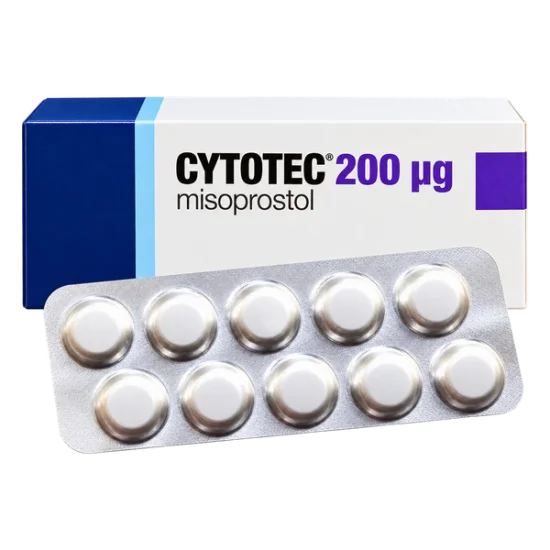
Misoprostol, the active ingredient in Cytotec, is a synthetic prostaglandin E1 analogue supplied as 200 microgram tablets. It is used under medical supervision for gastric protection and selected obstetric or gynaecological indications, including medication-abortion protocols.
Pharmacological action
Misoprostol is converted to its active acid form after administration. This metabolite binds to prostaglandin receptors and produces several physiological effects:
- Reduced gastric acid secretion.
- Increased protective mucus and bicarbonate production.
- Increased uterine muscle activity.
- Cervical ripening, meaning the cervix becomes softer and more receptive to opening.
- Gastrointestinal stimulation, which can cause diarrhoea, nausea, or abdominal discomfort.
The term “prostaglandin analogue” describes a medicine that imitates the action of naturally occurring prostaglandins. These chemical messengers regulate inflammation, smooth-muscle activity, blood flow, and protective processes in the stomach.
Cytotec is also used in clinical protocols involving pregnancy termination, where misoprostol causes uterine contractions after pregnancy-supporting tissue has been affected by mifepristone. The medicine does not treat an ectopic pregnancy, and a pregnancy located outside the uterus requires a different medical pathway.
What it contains
The product form is an oral tablet, with each tablet containing 200 micrograms of misoprostol.
Directions for use
- Dose: The regimen for the chosen strength depends on the indication and must be confirmed with a healthcare professional before starting.
- Frequency: The number of tablets and times per day are not specified here and must be confirmed for the chosen indication.
- Timing: The timing in relation to meals or time of day is not specified here; follow the healthcare professional’s instructions.
- Duration: The treatment duration is not specified here and must be confirmed for the chosen indication.
- Route: Cytotec is supplied as tablets; use the route directed by a healthcare professional. Do not use it as a self-directed substitute for pregnancy assessment.
- Medication abortion: When clinically appropriate, misoprostol is commonly used after mifepristone, with the regimen confirmed by a healthcare professional.
Reasons not to use it
Important exclusions and precautions include:
- Suspected or confirmed ectopic pregnancy when the treatment plan has not addressed it.
- Unexplained heavy vaginal bleeding.
- Severe anaemia or a significant bleeding disorder.
- Current anticoagulant treatment without clinical review.
- Serious cardiovascular disease requiring individual risk assessment.
- Allergy to misoprostol or other prostaglandin medicines.
- Inability to obtain urgent medical care if severe bleeding or pain develops.
- A pregnancy that the person intends to continue, because misoprostol can cause uterine contractions and pregnancy loss.
- Breastfeeding when the indication and timing have not been assessed.
For gastric-ulcer prevention, Cytotec is contraindicated during pregnancy because uterine contractions may cause miscarriage or premature labour. For obstetric indications, the pregnancy status and treatment purpose are assessed before administration. The European Medicines Agency identifies misoprostol’s uterotonic effects as a central safety consideration.[3]
Interactions require review. Non-steroidal anti-inflammatory medicines may be used for cramping in many protocols, but kidney disease, ulcer history, anticoagulants, and aspirin change the risk profile. Magnesium-containing antacids can worsen misoprostol-related diarrhoea.
When this is not for you
Cytotec is not appropriate for everyone. This medication is not for you if you have a known allergy to misoprostol or prostaglandins, or if a clinician has identified a condition requiring a different treatment.
It may not be suitable if you have unexplained heavy bleeding, severe anaemia, a bleeding disorder, serious heart disease, or cannot obtain urgent medical care if severe pain or bleeding develops. You should also speak with a clinician before use if you take anticoagulants, have kidney disease or a history of stomach ulcers, are breastfeeding, or intend to continue the pregnancy.
Adverse reactions
Cramping and vaginal bleeding are expected pharmacological responses when misoprostol acts on the uterus. Cramping may begin after administration and can range from mild discomfort to strong contractions. Bleeding may be heavier than a usual menstrual period and can include clots.
Other recognised effects include:
- Nausea or vomiting.
- Diarrhoea.
- Headache.
- Dizziness.
- Chills or temporary fever.
- Fatigue.
- Abdominal discomfort.
The intensity and timing vary with the indication, dose, route, pregnancy duration, and individual response. Gastrointestinal symptoms occur because prostaglandin receptors are also present in the digestive tract.
Urgent assessment is needed for very heavy bleeding, fainting, severe or one-sided abdominal pain, shoulder-tip pain, persistent high fever, worsening weakness, or foul-smelling vaginal discharge. These symptoms can indicate haemorrhage, ectopic pregnancy, infection, or incomplete treatment.
Bleeding that becomes progressively lighter is generally different from bleeding that rapidly saturates multiple large pads. A person who feels faint, confused, unusually weak, or short of breath needs urgent medical attention rather than continued observation at home.

Uses
Medication abortion commonly uses mifepristone followed by misoprostol when both medicines are clinically appropriate. Mifepristone blocks progesterone activity, while misoprostol stimulates uterine contractions and cervical change. The two medicines act at different stages of the same physiological process.[1]
Misoprostol also has established non-obstetric use in the prevention of gastric ulcers associated with certain non-steroidal anti-inflammatory drugs. The dose and schedule for gastric protection are different from those used in gynaecological care.
Comparison
Medication abortion and surgical abortion are distinct clinical approaches. The appropriate option depends on gestational age, medical findings, patient preference, local clinical practice, and the ability to obtain urgent care if complications occur.
| Feature | Medication abortion | Surgical abortion |
|---|---|---|
| Main process | Medicines cause uterine contraction and expulsion | A clinician empties the uterus using an established procedure |
| Physical experience | Cramping and bleeding occur over a variable period | The procedure is usually shorter, with post-procedure cramping or bleeding |
| Confirmation | Follow-up testing, examination, or ultrasound may be required | Clinical assessment confirms completion during or after the procedure |
Medication abortion can involve more bleeding and cramping at home. Surgical treatment may provide faster completion and direct clinical confirmation, but it involves an invasive procedure and may require anaesthesia or sedation.
An ultrasound can help confirm pregnancy location and gestational age before treatment when clinical assessment indicates it. A pregnancy test alone cannot diagnose an ectopic pregnancy or confirm that the uterus is empty after treatment.
The recovery pattern differs between individuals. Light bleeding can continue after the main episode, while pregnancy symptoms may take time to resolve because hormone levels decline gradually. Cramping often eases as the uterus contracts and bleeding becomes lighter. Follow-up instructions should be followed even when symptoms improve. Persistent or worsening symptoms need clinical review.
Common mistakes
Several practical errors can make Cytotec treatment less predictable or delay recognition of complications:
- Treating a positive pregnancy test as proof that the pregnancy is inside the uterus.
- Starting before the prescribed regimen has been confirmed.
- Confusing micrograms with milligrams.
- Assuming Cytotec contains mifepristone.
- Taking aspirin for cramping without checking its bleeding effect.
- Using multiple anti-inflammatory painkillers together.
- Ignoring one-sided abdominal pain because bleeding has started.
- Discarding follow-up testing because symptoms seem complete.
- Taking an additional dose after a short delay without medical instructions.
- Relying on a single home pregnancy test too soon after treatment.
One subtle issue is that pregnancy hormone levels do not disappear immediately. A positive test shortly after treatment may reflect hormone decline rather than ongoing pregnancy, so follow-up timing should be set by the treating service.
What doctors say
In clinical practice, doctors focus first on pregnancy location, gestational age, bleeding risk, medication history, and the person’s access to emergency support. Misoprostol can produce predictable cramping and bleeding, but the response does not confirm treatment completion by itself.
A physician also considers ectopic-pregnancy risk. Misoprostol does not remove an ectopic pregnancy, so one-sided pain, shoulder pain, fainting, or unexplained collapse requires urgent assessment.
Doctors usually explain that nausea, chills, and diarrhoea can occur soon after misoprostol, while bleeding and cramping may follow a different timeline. A lack of bleeding does not always prove that treatment failed, and heavy bleeding does not always prove completion.
The World Health Organization describes medication abortion as a clinical process that includes eligibility assessment, appropriate medicines, information, and follow-up access rather than tablets alone.[2]
Questions and answers
What condition rules out Cytotec use?
A suspected ectopic pregnancy rules out using Cytotec as a complete treatment because misoprostol does not remove a pregnancy outside the uterus. The National Institute for Health and Care Excellence addresses ectopic-pregnancy assessment as a separate clinical pathway in its guidance reviewed through 2025. One-sided pain, shoulder-tip pain, fainting, or collapse needs urgent assessment rather than additional tablets.
What happens when Cytotec is stopped, and does it require tapering?
Misoprostol used for a short prescribed course is not usually tapered like a corticosteroid or antidepressant. Its effects decline as the active metabolite is cleared, while cramping and bleeding may continue for a variable period. FDA prescribing information reviewed in 2025 describes misoprostol as a short-acting prostaglandin analogue, but the treating clinician decides whether any further dose is needed.
Can Cytotec be taken with food or on an empty stomach?
The correct administration method depends on the prescribed indication and route. Food may reduce some stomach upset, but it does not replace the timing or route selected for an obstetric regimen. The EMA (2015) product information for misoprostol-containing medicines describes gastrointestinal effects and route-specific instructions, which should be confirmed before starting.
Is Cytotec suitable for older adults?
Older adults may receive misoprostol for gastric protection, but kidney function, dehydration risk, diarrhoea, and other medicines require attention. Age alone does not determine suitability, although severe diarrhoea can cause complications more quickly in a person with reduced physiological reserve. WHO clinical guidance updated through 2025 supports individual assessment when medicines may cause fluid loss or bleeding.
How long does one dose of Cytotec keep working?
The strongest uterine effects often occur during the hours after administration, but the timing varies with route, dose, pregnancy duration, and individual response. Bleeding or cramping can continue after the main pharmacological effect has begun to decline. The FDA Cytotec label (2002) describes rapid conversion to the active metabolite, while clinical symptoms may last longer than the drug’s blood concentration.
How soon does the effect become noticeable?
Gastrointestinal or uterine effects may appear within hours, though some people experience a later onset. The presence or absence of immediate cramping does not establish whether treatment has succeeded. The American College of Obstetricians and Gynecologists (2020) discusses follow-up assessment because symptoms alone cannot reliably confirm completion.
Can Cytotec be used during pregnancy or breastfeeding?
Cytotec can cause uterine contractions and pregnancy loss, so it must not be used during an ongoing pregnancy unless it has been prescribed for a specific obstetric indication. Breastfeeding advice depends on the indication, dose, timing, and local clinical guidance. The EMA (2015) and WHO (2022) both treat pregnancy status and reproductive intention as central factors when misoprostol is considered.
Do you offer anonymous delivery?
Your order will be securely packed and shipped within 24 hours. This is exactly what your package will look like (images of an actual item sent). It has the size and look of a regular private letter (24x11x0.7 cm) and its contents cannot be seen.
Sources
- U.S. Food and Drug Administration (2002). Cytotec (misoprostol) Prescribing Information
- World Health Organization (2022). Abortion care guideline
- European Medicines Agency (2015). MisoOne: European public assessment report