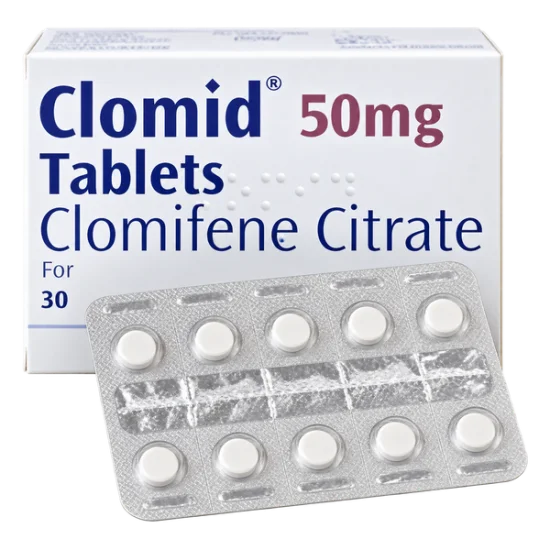
Hatta, used 50 mg of Clomid under medical supervision for several weeks for a male hormone problem. He reported improved energy after several weeks, but also noticed headaches and needed repeat blood tests before continuing.
Clomid is an oral tablet containing clomiphene citrate, used for ovulation induction when irregular or absent ovulation contributes to difficulty conceiving. It may help a developing follicle mature and may trigger ovulation through the LH surge. How much to use and how often depends on the treatment purpose and is agreed with a doctor or pharmacist.
About this product
Clomid contains clomiphene citrate and is supplied as oral tablets. Clomiphene is classified as a selective oestrogen receptor modulator, or SERM. How much to use and how often depends on the purpose of treatment and should be agreed with a doctor or pharmacist.
Pharmacological action
Clomiphene works by reducing oestrogen feedback at the hypothalamus and pituitary gland. The brain then receives a weaker signal that enough reproductive hormone is circulating. In response, the hypothalamus releases more gonadotropin-releasing hormone, or GnRH.
GnRH stimulates the pituitary gland to release two reproductive hormones:
- Follicle-stimulating hormone, or FSH: supports follicle development in the ovaries and acts on Sertoli cells in the testes.
- Luteinising hormone, or LH: helps trigger ovulation and stimulates Leydig cells to produce testosterone.
This hormonal cascade explains why the same active ingredient can be used in different reproductive settings. In women, the aim is usually follicular development followed by ovulation. In men, increased LH and FSH may support testosterone production and sperm development when the pituitary–testicular pathway remains responsive.
Endocrine cascade and gonadotropin release
The sequence can be understood in five stages:
- Clomiphene blocks some oestrogen-receptor feedback in the hypothalamus.
- The hypothalamus releases more GnRH.
- The pituitary gland responds with increased FSH and LH secretion.
- FSH supports ovarian follicles or Sertoli-cell activity.
- LH supports ovulation or Leydig-cell testosterone production.
Clomiphene differs from an oestrogen replacement product and from injectable gonadotropins. It does not directly provide FSH or LH. It encourages the body to increase its own release of these hormones, which is why ovarian monitoring and endocrine testing can be needed.
The American Society for Reproductive Medicine describes ovulation induction as a treatment that should be matched to the cause of anovulation, ovarian reserve, semen findings and other fertility factors [2].
What it contains
Clomid contains clomiphene citrate and is supplied as oral tablets. Clomiphene is classified as a selective oestrogen receptor modulator, or SERM. This class acts on oestrogen receptors in a tissue-dependent way, changing how the brain interprets circulating oestrogen.
The medicine is used mainly for ovulation induction in women who do not ovulate regularly. Clomiphene is also used off-label in some male infertility and testosterone-management plans. The male use is different from the licensed female fertility indication and requires specialist assessment.
The key pharmaceutical facts are:
- Active ingredient: clomiphene citrate
- Drug class: selective oestrogen receptor modulator
- Route: oral administration
- Main reproductive use: stimulation of ovulation
- Other specialist use: selected male endocrine and fertility conditions
The FDA prescribing information describes clomiphene as a non-steroidal fertility medicine that acts through the hypothalamic–pituitary–gonadal system [1].
Directions for use
How much to use and how often depends on the purpose of treatment and should be agreed with a doctor or pharmacist. Clomid is taken by mouth as a tablet.
A treatment plan may specify:
- The cycle day on which tablets begin.
- The number of consecutive treatment days.
- Whether ovulation testing or ultrasound monitoring is required.
- When intercourse or intrauterine insemination should be timed.
- Whether treatment should stop after a defined number of cycles.
- Which blood tests are needed before or during treatment.
Do not start a new cycle, extend a cycle or repeat tablets because ovulation has not occurred as quickly as expected. If a dose is missed, the appropriate action depends on the treatment schedule and cycle day; taking extra tablets can increase adverse effects and disrupt cycle planning.
Reasons not to use it
It should not be used during pregnancy, and it is not a treatment for unexplained infertility without assessment of the likely cause.
This medicine may be unsuitable when there is:
- Current pregnancy or suspected pregnancy.
- Ovarian cysts unrelated to PCOS.
- Uncontrolled thyroid or adrenal disease.
- Unexplained abnormal uterine bleeding.
- Significant liver disease or a history of liver dysfunction linked to treatment.
- Previous serious hypersensitivity to clomiphene or an ingredient.
- Visual symptoms that began during earlier clomiphene treatment.
- Ovarian enlargement that is not caused by PCOS.
- A condition where pregnancy would carry unacceptable medical risk.
Clomid can interact with the wider fertility-treatment plan even when it has no major direct interaction with another medicine. Tell the prescriber about hormone therapy, fertility injections, medicines for thyroid disease, liver disease, seizures, migraine or mood disorders.
When this is not for you
Clomid is not for you if you are pregnant, have unexplained bleeding, significant liver disease or treatment-related visual symptoms. It also cannot guarantee conception.
Driving and machinery work should be avoided if dizziness, blurred vision or other visual symptoms occur.
Adverse reactions
Clomid can cause adverse effects in women and men. Commonly reported problems include hot flashes, headaches, breast discomfort, nausea, mood swings, visual symptoms and pelvic discomfort. Some effects are linked to changes in oestrogen signalling rather than direct toxicity.
Possible effects include:
- Hot flashes or night sweats.
- Headache or dizziness.
- Nausea, bloating or abdominal discomfort.
- Mood changes, irritability or low mood.
- Breast tenderness.
- Ovarian enlargement or ovarian cysts.
- Light or heavier menstrual bleeding.
- Temporary visual disturbance.
Visual symptoms deserve special attention. Blurred vision, flashes, spots or increased sensitivity to light can occur during treatment and may become persistent in rare cases. Stop taking further tablets and seek urgent medical assessment if significant visual changes develop.
Ovarian hyperstimulation is less common with oral clomiphene than with some injectable stimulation protocols, but it can still occur. Severe abdominal pain, marked abdominal swelling, rapid weight gain, vomiting or shortness of breath requires urgent assessment.
The FDA label identifies visual symptoms, ovarian enlargement and multiple pregnancy as clinically relevant risks associated with clomiphene treatment [4].
Mood changes can be subtle. A partner may notice irritability or emotional lability before the person taking Clomid recognises a pattern. Persistent depression, agitation or severe anxiety should be reported promptly.
Alcohol may worsen dizziness or impair judgement when combined with treatment-related symptoms. Driving and machinery work should be avoided if dizziness, blurred vision or other visual symptoms occur.
Women with PCOS may have a higher risk of multiple follicular development. Men using clomiphene off-label may require monitoring for oestradiol-related symptoms, mood changes, breast tenderness and visual effects.
Uses
Clomid is used for ovulation induction when irregular or absent ovulation contributes to difficulty conceiving. Polycystic ovary syndrome, or PCOS, is one possible cause of anovulation. Other causes include thyroid disorders, raised prolactin, low energy availability, significant weight changes and reduced ovarian function.
Clomiphene may help a developing follicle reach maturity and may trigger ovulation through the LH surge. Treatment planning can include cycle timing, ultrasound monitoring, hormone testing and assessment of the fallopian tubes or semen, depending on the clinical situation.
A fertility clinician may consider:
- Whether ovulation is absent, irregular or already occurring.
- Whether PCOS is present.
- Ovarian reserve and age-related fertility factors.
- Semen analysis for the male partner.
- Tubal patency and pelvic factors.
- The risk of multiple pregnancy.
- The number of previous clomiphene cycles.
Clomid may be suitable for some women with ovulatory dysfunction, but it does not correct blocked fallopian tubes, severe endometriosis or severe male-factor infertility.
Clomiphene citrate is sometimes used off-label in men with low testosterone, secondary hypogonadism or selected sperm-production problems. The aim is to stimulate the man’s own hormonal system rather than replace testosterone directly.
This approach may be considered when preserving fertility is a priority. Exogenous testosterone can suppress pituitary gonadotropins and reduce sperm production, whereas clomiphene may preserve or stimulate endogenous gonadotropin signalling in selected men.
Clomid can be included in a broader fertility plan involving timed intercourse or intrauterine insemination. In an IUI cycle, ovulation induction may be followed by monitoring and placement of prepared sperm in the uterus around the expected ovulation period.
In vitro fertilisation follows a different process. Eggs are stimulated, collected and fertilised outside the body before embryo transfer. Clomiphene may be considered in some lower-intensity or specialised protocols, but it is not a universal component of IVF.
The American Urological Association and American Society for Reproductive Medicine describe hormonal evaluation and fertility-preserving treatment choices as part of male infertility assessment [3].
The World Health Organization fertility guidance supports cause-based assessment rather than treating every fertility problem with the same medicine [5].

Comparison
Clomid is one option within fertility care. The choice depends on the cause of infertility, hormone results, ovarian reserve, semen findings, previous treatment and the risk profile of each approach.
| Approach | Main action | Typical clinical role |
|---|---|---|
| Clomiphene | Increases the body’s release of FSH and LH | Oral ovulation induction in selected patients |
| Letrozole | Reduces oestrogen production temporarily | Ovulation induction, often considered in PCOS |
| Injectable gonadotropins | Directly provide FSH, with or without LH activity | More intensive stimulation requiring close monitoring |
Letrozole and clomiphene are not interchangeable without a treatment decision. Some people with PCOS may receive letrozole because of its ovulation and pregnancy outcomes in that setting, while clomiphene remains a recognised oral option.
Injectable gonadotropins can recruit several follicles and require closer ultrasound monitoring. They may be used when oral induction is unsuitable or unsuccessful, though the risk of ovarian over-response and multiple pregnancy requires careful management.
Clomid may also be used alongside timed intercourse or intrauterine insemination.
In vitro fertilisation uses a separate stimulation and egg-retrieval pathway, and clomiphene is not automatically part of every IVF protocol.
Common mistakes
Several practical errors can reduce the usefulness of treatment or delay recognition of complications:
- Starting tablets on the wrong cycle day.
- Repeating a missed dose without advice.
- Continuing treatment after the agreed number of cycles.
- Ignoring blurred vision or flashing lights.
- Assuming that a positive ovulation test confirms pregnancy.
- Skipping semen analysis when male-factor infertility is possible.
- Treating PCOS as the only possible cause of anovulation.
- Using clomiphene for testosterone symptoms without checking LH, FSH and related hormones.
- Taking fertility injections at the same time without a coordinated plan.
- Relying on symptoms alone instead of attending scheduled monitoring.
One detail experienced fertility teams often emphasise is the difference between follicle growth and a successful ovulation. Ultrasound can show developing follicles, while blood testing or cycle tracking may help confirm whether ovulation occurred.
What doctors say
In clinical practice, fertility specialists usually focus on the reason ovulation is irregular before selecting Clomid. The medicine works best when the ovaries can respond and no major tubal or sperm-related barrier has been overlooked.
A doctor will often set a clear stopping point for treatment. Repeated cycles without ovulation, persistent visual symptoms, ovarian enlargement or absent pregnancy may lead to a different approach.
For male infertility, clinicians usually explain that clomiphene is an off-label option. Testosterone symptoms, blood-test results and semen parameters may improve at different speeds, and one result cannot represent the entire response.
Patients should also understand that a positive ovulation test is not the same as a confirmed pregnancy. Ovulation is one stage in conception, not a guarantee of embryo implantation.
Questions and answers
Can Clomid affect driving, concentration or machinery work?
Clomid may cause headache, dizziness or visual disturbances, which can affect driving and machinery work. The FDA prescribing information highlights visual symptoms as a reason for prompt medical attention, and this warning remains clinically relevant in 2026. Do not drive or operate machinery while vision is blurred, flashing, distorted or unusually sensitive to light.
What happens after stopping Clomid, and does treatment need tapering?
Clomid is generally used in defined treatment cycles rather than reduced gradually over time. The 2012 FDA label describes cycle-based administration, so tapering is not usually the standard approach. Ovulation or hormone effects may continue briefly after a course, while the underlying fertility problem can return if it remains untreated.
Do you offer anonymous delivery?
Your order will be securely packed and shipped within 24 hours. This is exactly what your package will look like (images of an actual item sent). It has the size and look of a regular private letter (24x11x0.7 cm) and its contents cannot be seen.
Sources
- U.S. Food and Drug Administration (2012). Clomid (clomiphene citrate) prescribing information.
- American Society for Reproductive Medicine (2021). Evidence-based treatments for couples with unexplained infertility: a guideline.
- American Urological Association and American Society for Reproductive Medicine (2020). Diagnosis and Treatment of Infertility in Men: AUA/ASRM Guideline.
- U.S. Food and Drug Administration (2012). Clomiphene citrate tablets: prescribing information and safety information.
- World Health Organization (2023). WHO guideline for the prevention, diagnosis and treatment of infertility.