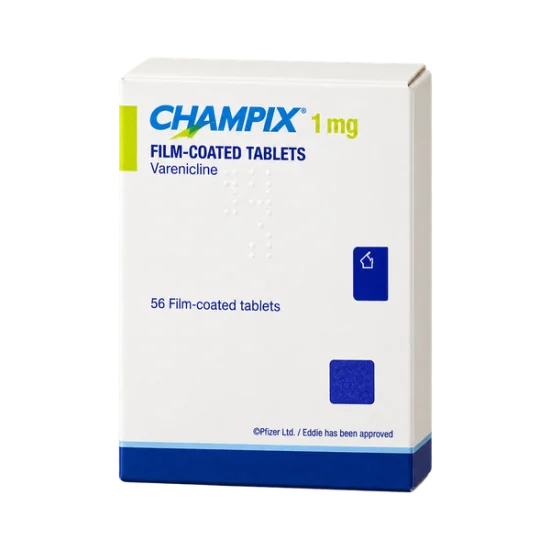
I used the tablets during a planned quit attempt. The cravings were still present in the first week, but cigarettes became less satisfying. Nausea after the morning dose settled when I took it after breakfast.
Champix works through varenicline, which partially stimulates nicotine receptors while reducing the satisfaction linked to smoking. It is intended for adults who want to stop smoking and need help controlling cravings and withdrawal. The treatment works best alongside a defined quit plan.
About this product
Champix contains varenicline and is used as a prescription aid for smoking cessation in adults. It belongs to the smoking-cessation medicines that act directly on nicotine receptors in the brain. The product is supplied as film-coated tablets, with 56 tablets in the pack. The dose is decided individually, taking age, other medicines, and health conditions into account.
Pharmacological action
Varenicline is a partial agonist at the alpha-4 beta-2 nicotinic acetylcholine receptor. In plain language, it attaches to the receptor and produces a weaker signal than nicotine. This gives the nervous system some stimulation, which can soften withdrawal, while limiting the receptor response produced by a cigarette.
Nicotine normally causes a rapid increase in receptor activity and contributes to dopamine release in the brain’s reward pathways. Varenicline occupies many of the same receptor sites. A cigarette smoked during treatment may therefore produce less satisfaction because nicotine has less opportunity to create its usual full effect. The mechanism and clinical dosing information are described in the European Medicines Agency product information for varenicline [1].
A useful expectation is gradual control rather than a sudden disappearance of every craving. Short urges may still occur, especially after meals or during emotional stress. The difference is that the urge can become less intense and less rewarding to act on.
Patients sometimes make a practical mistake during the first week: they continue smoking automatically and then conclude that the treatment has failed. Varenicline reduces reinforcement; it does not prevent a person from lighting a cigarette through habit.
What it contains
Champix contains varenicline. The product is supplied as film-coated tablets, with 56 tablets in the pack. The dose is decided individually, taking age, other medicines, and health conditions into account.
Directions for use
Champix is taken orally as film-coated pills. The dose is decided individually, taking age, other medicines, and health conditions into account.
Use the prescribed schedule exactly. A typical clinical plan includes a gradual start before the planned quit date, followed by regular dosing during the active quitting period. The prescriber may select a lower starting dose or a slower increase when kidney function, tolerability, age, or other treatment requires it.
Key administration points include:
- Swallow the tablet with water.
- Take it at the times selected in the prescription.
- Taking it after food may reduce nausea for some people.
- Do not crush or chew a film-coated tablet unless a prescriber gives different instructions.
- If a dose is missed, take it when remembered unless the next dose is due soon.
- Do not take two doses together to compensate for a missed dose.
- Continue the planned course unless the prescriber changes it.
Kidney function can affect varenicline exposure. Older adults may also need a careful review of renal function because kidney clearance tends to decline with age. The FDA prescribing information describes dose adjustment considerations in renal impairment [2].
Reasons not to use it
Clinical review is needed before starting when there is:
- Known allergy to varenicline.
- Significant kidney disease or dialysis.
- A history of severe depression, suicidal thoughts, psychosis, or bipolar disorder.
- Pregnancy, planned pregnancy, or breastfeeding.
- Previous serious reaction to a smoking-cessation treatment.
- Use of medicines that cause sedation or affect mental alertness.
When this is not for you
Champix is not suitable for everyone. This treatment is not for you if you have had a serious allergic reaction to varenicline or any tablet ingredient. It also requires specific medical assessment when kidney function is reduced, when there is a history of severe psychiatric illness, or when pregnancy or breastfeeding is involved.
Adverse reactions
The most frequent unwanted effects include nausea, abnormal dreams, insomnia, headache, dry mouth, constipation, and fatigue. Nausea is often more noticeable during dose escalation and may become less troublesome with continued treatment. Sleep changes can present as difficulty falling asleep, waking during the night, or unusually vivid dreams.
Possible side effects include:
- Nausea or stomach discomfort.
- Headache.
- Constipation or dry mouth.
- Insomnia or vivid dreams.
- Dizziness or tiredness.
- Changes in mood or irritability.
A person who feels dizzy or unusually sleepy should avoid driving until the effect is clear. Severe or persistent mood changes, suicidal thoughts, severe agitation, facial swelling, breathing difficulty, or a serious skin reaction require urgent medical attention.
One practical detail is easy to miss: vivid dreams may be more disruptive when the tablet is taken close to bedtime. If sleep becomes difficult, the dosing schedule may need clinical adjustment rather than abrupt self-discontinuation.
Some people experience a temporary increase in irritability after stopping cigarettes. This can be nicotine withdrawal rather than a direct adverse reaction to varenicline, although a marked change in mood should still be assessed.
Uses
The clinical aim is complete tobacco cessation rather than simply reducing the number of cigarettes. Champix may help by:
- Reducing the intensity of nicotine cravings.
- Easing withdrawal symptoms during the quitting period.
- Decreasing the pleasurable effect of smoking.
- Supporting adherence to a planned quit date.
- Helping adults remain smoke-free after stopping.
A quit plan should identify the intended stop-smoking date, smoking triggers, and practical alternatives for stressful situations. Medication supports the process; it does not remove the learned routines connected with coffee, driving, social situations, or work breaks.
Comparison
Champix differs from nicotine replacement because it acts at nicotine receptors without supplying nicotine. Other prescription approaches affect brain chemistry through different pathways. A clinician chooses between these categories after reviewing smoking intensity, previous quit attempts, mental health history, kidney function, pregnancy status, and other medicines.
| Approach | Main action | Practical limitation |
|---|---|---|
| Varenicline | Partially stimulates alpha-4 beta-2 nicotine receptors and reduces nicotine reward | Nausea, sleep changes, and dose adjustment may occur |
| Nicotine replacement | Provides controlled nicotine through oral, transdermal, or mucosal routes | Cravings may continue, and correct use of the chosen form matters |
| Non-nicotine antidepressant approach | Alters neurotransmitter activity linked with craving and withdrawal | Contraindications and interactions can limit suitability |
Varenicline can be useful when the main difficulty is strong nicotine reward and repeated relapse after a quit attempt. Nicotine replacement may suit someone who prefers a gradual reduction in nicotine exposure. Combining treatments requires a planned clinical decision rather than self-directed mixing.
The Cochrane review of pharmacological interventions for smoking cessation found that varenicline improves quit rates compared with placebo, while also identifying nausea and sleep-related effects as common treatment limitations [3].
Common mistakes
Several patterns can reduce the benefit of Champix:
- Starting tablets without choosing a quit date.
- Taking doses inconsistently and then judging the treatment too early.
- Doubling the next dose after forgetting one.
- Ignoring persistent nausea and stopping suddenly without clinical advice.
- Continuing to smoke automatically during familiar routines.
- Using alcohol heavily while assessing mood and concentration.
- Driving soon after a dose when dizziness or sleepiness is present.
- Failing to mention kidney disease or psychiatric history.
- Treating one cigarette as proof that the whole quit attempt has failed.
A lapse is a clinical event to review, not a reason to abandon the plan. Identify what happened, remove the immediate trigger, and return to the agreed cessation strategy.
What doctors say
In clinical practice, prescribers usually set expectations around the first two weeks rather than promising an effortless quit. The medicine can reduce receptor-driven cravings, yet routines, stress, and social cues still require active planning.
A physician will usually review smoking quantity, previous cessation attempts, mental health symptoms, kidney function, and concurrent medicines before selecting the regimen. Follow-up is useful when nausea, insomnia, mood changes, or persistent cravings interfere with progress.
The World Health Organization recommends combining behavioural support with pharmacological treatment for adults who want to stop tobacco use. The National Institute for Health and Care Excellence (NICE) also supports behavioural and pharmacological support for smoking cessation. Its tobacco-cessation guidance published in 2024 supports structured treatment rather than relying on medication without a quit strategy [4].
A useful clinical observation is that a person may still smoke during the early treatment period without the usual sense of reward. That change can be used constructively: delay the cigarette, identify the trigger, and allow the urge to pass instead of treating one lapse as a failed attempt.
Questions and answers
Can older adults use Champix?
Older adults may use varenicline when a prescriber considers renal function, other medicines, and treatment tolerability. Kidney clearance can decline with age, which may affect the dose selected. The FDA prescribing information reviewed in 2021 gives specific renal considerations for varenicline and supports individual dose selection. Monitoring is useful when dizziness, sleep changes, or confusion appears after starting treatment. Follow-up can confirm whether the selected dose remains suitable.
How soon does the effect of Champix become noticeable?
Some adults notice reduced cigarette satisfaction or less intense craving during the first week, while the full benefit may become clearer around the planned quit date. Withdrawal can still occur because the brain is adapting to lower nicotine exposure. The WHO tobacco-cessation guidance from 2024 describes pharmacotherapy as support for a broader quitting plan rather than an instant removal of dependence. Early progress should be judged by craving intensity, cigarette enjoyment, and ability to delay smoking.
What happens when Champix is stopped, and does it need tapering?
Varenicline is not nicotine, so stopping it does not recreate the same nicotine withdrawal pattern caused by suddenly stopping cigarettes. Some people may notice returning cravings if behavioural triggers remain active, especially after a short treatment course. The European Medicines Agency product information available from 2006 describes the treatment course and discontinuation considerations for varenicline. Do not extend, shorten, or taper the course independently; the prescriber should decide how treatment ends.
What should I do after a missed Champix dose?
Take the missed dose when remembered unless the next scheduled dose is near. In that situation, skip the forgotten dose and resume the normal schedule. The FDA label from 2021 advises against taking extra tablets to compensate for a missed dose because this can increase adverse effects. A repeated pattern of missed doses may signal that the timing needs to be fitted better to the daily routine.
What is the best time of day to take Champix?
The best time depends on the prescribed schedule and how the person responds to the medicine. Taking a tablet after food with water may reduce nausea, while a dose close to bedtime may worsen vivid dreams or insomnia for some people. The EMA product information from 2006 supports regular administration according to the selected regimen. A prescriber can adjust timing when sleep or stomach symptoms interfere with continued treatment.
Can I drive, concentrate, or work with machinery while taking Champix?
Dizziness, sleepiness, visual changes, or difficulty concentrating can occur, especially when treatment begins or the dose changes. Do not drive or operate machinery until you know how Champix affects you. The WHO guidance published in 2024 supports reviewing treatment tolerability before returning to safety-sensitive tasks. Alcohol can worsen impaired judgement and should be avoided when it produces unusual changes in alertness or behaviour.
Do you offer anonymous delivery?
Your order will be securely packed and shipped within 24 hours. This is exactly what your package will look like (images of an actual item sent). It has the size and look of a regular private letter (24x11x0.7 cm) and its contents cannot be seen.
Sources
- European Medicines Agency (2006). Champix: European Public Assessment Report and Product Information.
- U.S. Food and Drug Administration (2021). CHANTIX (varenicline) Prescribing Information.
- Cochrane (2016). Pharmacological interventions for smoking cessation: an overview and network meta-analysis.
- World Health Organization (2024). WHO clinical treatment guideline for tobacco cessation in adults.