Waleed, 63 - Al Khawaneej, used the spray during a heavy cold for two nights. He reported that nasal breathing improved quickly, though the first application caused mild stinging. He stopped once he could sleep without blockage.
Oxymetazoline hydrochloride, the active ingredient of Afrin, is a topical nasal decongestant for adults and age-appropriate paediatric use. It narrows swollen blood vessels in the nasal lining, helping relieve blocked breathing caused by colds, allergic rhinitis, or sinus irritation.
About this product
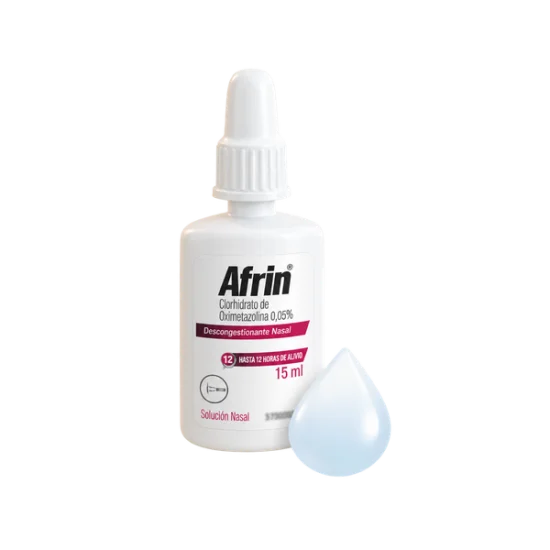
Afrin is a nasal spray containing oxymetazoline hydrochloride, a topical sympathomimetic decongestant. It is applied inside the nose to reduce mucosal swelling and improve airflow. The product is supplied as a spray in a bottle, with a 15 ml presentation.
Oxymetazoline hydrochloride belongs to the imidazoline group of nasal decongestants.
Pharmacological action
Oxymetazoline stimulates alpha-adrenergic receptors on vascular smooth muscle. These receptors are found in the small blood vessels supplying the nasal mucosa. Their activation causes vasoconstriction, which reduces the volume of swollen tissue inside the nasal passages.
The practical effect is easier nasal breathing. Afrin does not remove mucus by washing it away, and it does not eliminate the virus or allergen causing the original inflammation. It reduces one major part of congestion: blood-vessel dilation and mucosal oedema.
Vascular Constriction and Oedema Reduction
During a cold or allergic reaction, inflammatory signals make nasal blood vessels wider and more permeable. Fluid then moves into surrounding tissue, producing the familiar blocked or “stuffed-up” sensation. Oxymetazoline limits this vascular expansion.
The nose may feel more open soon after application. The degree of relief depends on the cause of congestion, the amount of swelling, nasal anatomy, and whether mucus or crusting also contributes to obstruction.
The National Library of Medicine describes this pattern as rhinitis medicamentosa, a form of medication-related nasal congestion [2].
What it contains
Afrin is a nasal spray containing oxymetazoline hydrochloride, a topical sympathomimetic decongestant. It is applied inside the nose to reduce mucosal swelling and improve airflow. The product is supplied as a spray in a bottle, with a 15 ml presentation.
Directions for use
Dosing differs between strengths and between users, so there is no single amount that suits everyone. Use the age-appropriate dose and frequency specified by the product’s regulatory directions. Do not increase the number of sprays or extend treatment to compensate for incomplete relief.
Proper Spray Technique
- Gently clear the nose before application.
- Keep the head upright or slightly forward.
- Place the nozzle just inside one nostril.
- Aim away from the nasal septum.
- Apply the prescribed spray while breathing in gently.
- Repeat on the other side only when the dosing directions require it.
- Wipe the nozzle after use and keep the spray for one person only.
Avoid forceful sniffing immediately after spraying. Strong inhalation can move liquid into the throat and leave an unpleasant taste without improving nasal coverage.
Recommended Dosing Schedule
Short-term use is the central safety principle. Many clinical references advise limiting topical nasal decongestants such as oxymetazoline to no more than three consecutive days unless a clinician has given a specific plan.
Missed applications do not require a double application. Resume the next scheduled application only if continued use remains appropriate. Applying extra sprays increases exposure without reliably producing better airflow.
Reasons not to use it
- Uncontrolled hypertension or serious cardiovascular disease
- Certain heart rhythm disorders
- Narrow-angle glaucoma
- Hyperthyroidism
- Significant prostate-related urinary retention
- Previous serious reaction to oxymetazoline or related sympathomimetics
- Recent nasal surgery unless specifically permitted by the treating clinician
Monoamine oxidase inhibitors and some medicines for depression can increase concern about sympathomimetic effects. A medication review is needed when a person uses an MAOI, tricyclic antidepressant, stimulant, or several blood-pressure medicines.
When this is not for you
Afrin is not for you if you have any of the following conditions, unless a clinician advises otherwise:
- Uncontrolled hypertension or serious cardiovascular disease
- Certain heart rhythm disorders
- Narrow-angle glaucoma
- Hyperthyroidism
- Significant prostate-related urinary retention
- Previous serious reaction to oxymetazoline or related sympathomimetics
- Recent nasal surgery unless specifically permitted by the treating clinician
Adverse reactions
The most common local effects are temporary burning, stinging, dryness, sneezing, or increased nasal discharge. Minor nosebleeds may occur when the nasal lining is irritated, especially if the nozzle repeatedly touches the septum.
Some users experience headache, restlessness, nervousness, or difficulty sleeping. These effects may reflect systemic sympathomimetic activity and are more concerning when the product is used more often than directed.
Understanding Rebound Congestion
Rhinitis medicamentosa develops when nasal decongestant sprays are used beyond the recommended short period. The spray initially opens the nose, but congestion returns as its effect fades. The person may then apply it again, creating a cycle of temporary relief followed by worsening blockage.
Patients often mistake rebound swelling for ongoing infection or allergy. That mistake can lead to repeated applications over several days. The result may be persistent obstruction even after the original cold has resolved.
Tachyphylaxis also matters. The same number of sprays may seem less helpful, encouraging escalation. Increasing the dose does not correct the underlying rebound process.
A clinician may recommend stopping the decongestant and using another approach for the underlying condition. In selected cases, a corticosteroid nasal spray is used during withdrawal, but the choice depends on symptoms, medical history, and local prescribing practice.
Uses
Afrin may be considered for nasal blockage associated with:
- Common colds
- Seasonal or perennial allergic rhinitis
- Sinus pressure accompanied by swollen nasal passages
- Temporary nasal obstruction during an upper-respiratory infection
Children require age-appropriate formulations and directions. An adult nasal spray should not be assumed to be suitable for a child solely because the child has similar symptoms.
Food and Drug Administration describes oxymetazoline nasal products as topical decongestants for temporary relief of nasal congestion [1].
Comparison
Afrin delivers oxymetazoline directly to the nasal lining. Oral decongestants act throughout the body, while saline products work by moistening tissue and mechanically loosening mucus.
| Option | Main action and practical limitation |
|---|---|
| Afrin, oxymetazoline spray | Local vasoconstriction with rapid relief; prolonged use can cause rebound congestion |
| Oral pseudoephedrine or phenylephrine | Systemic decongestion; may cause insomnia, palpitations, or blood-pressure effects |
| Saline nasal spray or irrigation | Moisturises and cleanses the nose; does not directly constrict swollen blood vessels |
Topical Versus Oral Decongestants
A topical spray places the active substance at the site of obstruction. Systemic exposure is generally lower than with an oral decongestant, though it is not necessarily zero. Some oxymetazoline can be absorbed through nasal tissue, especially when used excessively or when the mucosa is damaged.
Pseudoephedrine can affect heart rate, sleep, and blood pressure because it circulates through the body. Phenylephrine also has systemic vascular activity, although its clinical benefit as an oral decongestant has been questioned in regulatory and pharmacology discussions.
People with hypertension, arrhythmia, hyperthyroidism, glaucoma, or prostate-related urinary difficulty need specific assessment before using sympathomimetic decongestants. A topical route does not remove every cardiovascular precaution.
Comparison with Saline Solutions
Saline nasal spray and saline irrigation provide moisture and help remove mucus, allergens, and crusts. They do not produce the same direct vasoconstrictor effect as oxymetazoline. Saline may be useful when dryness or thick secretions are the main problem.
A saline product does not carry the same rebound-congestion mechanism. Afrin has a strict short-term role because repeated alpha-receptor stimulation can alter the nasal response.
Common mistakes
Several practical errors reduce benefit or increase irritation:
- Spraying toward the nasal septum instead of the outer nasal wall
- Applying extra sprays when the first application feels insufficient
- Continuing treatment because congestion returns after each dose
- Sharing the spray with another person
- Using an adult formulation for a child without age-specific directions
- Sniffing forcefully and sending much of the liquid into the throat
- Treating chronic allergy symptoms with Afrin alone
- Forgetting that oral decongestants and stimulants may add sympathomimetic effects
- Using the spray just before sleep when it causes restlessness or palpitations
- Assuming that a blocked nose always means the original infection is worsening
One subtle mistake is using Afrin after the nose has become dry and cracked. The spray may sting more, and repeated contact with irritated tissue can promote bleeding. Moisture support and treatment of the underlying inflammation may be more appropriate.
Another is stopping and restarting the spray every few days without addressing the cause. That pattern can still maintain recurrent rebound symptoms.
What doctors say
ENT clinicians generally view oxymetazoline as a useful short-term tool for swollen nasal tissue, not as a daily treatment for chronic rhinitis. The clinical goal is to restore airflow temporarily while the cause of congestion is addressed.
A physician will usually ask how long the blockage has lasted, whether one or both nostrils are affected, whether fever or facial pain is present, and how often the spray is being used. Those details help separate a short-lived cold from allergic rhinitis, sinus disease, structural obstruction, or rhinitis medicamentosa.
The World Health Organization places emphasis on appropriate medicine use and avoiding unnecessary exposure. That principle fits Afrin well: use the smallest exposure that provides the intended short-term benefit, and avoid turning temporary relief into a repeated daily habit [3].
Persistent unilateral obstruction deserves medical assessment. So does congestion accompanied by recurrent nosebleeds, severe facial pain, high fever, breathing difficulty, or swelling around the eyes.
Questions and answers
What is the correct technique for using the Afrin spray device?
Keep the head upright or slightly forward, clear the nose gently, and direct the nozzle away from the nasal septum. Apply the prescribed amount while breathing in softly rather than sniffing forcefully. The 2020 FDA Drug Facts information for oxymetazoline nasal products supports short-term use and warns against exceeding the recommended frequency [4]. Clean the nozzle after application and do not share the device. Seek advice if bleeding or irritation persists.
What should I do if the expected nasal relief does not come?
Do not keep adding sprays when airflow does not improve. Check whether thick mucus, severe inflammation, structural blockage, or rebound congestion could be contributing, then seek clinical assessment if symptoms persist. Afrin reduces vascular swelling but does not treat every cause of nasal obstruction. A 2024 statement from the American Academy of Otolaryngology–Head and Neck Surgery supports evaluation when congestion is persistent, severe, recurrent, or associated with warning symptoms.
What should I do after a missed dose or application?
Skip the missed application if the next scheduled use is approaching. Do not double the amount or apply repeated sprays to compensate. Oxymetazoline has a short-term local role, so extra applications increase the risk of irritation and systemic effects without guaranteeing better relief. The 2023 National Health Service guidance advises against doubling doses of medicines after a missed dose unless a specific medicine instruction says otherwise [5].
Can Afrin be used during pregnancy or breastfeeding?
Pregnancy and breastfeeding require an individual risk assessment because oxymetazoline is a sympathomimetic decongestant. Occasional short-term use may be considered in some situations, but prolonged or frequent application is unsuitable without medical direction. A clinician may first suggest saline measures or another option based on the severity of nasal obstruction. Pregnancy guidance from the EMA and local medicines authorities, including 2024 updates, should be considered alongside the person’s blood pressure and obstetric history.
Which condition rules out Afrin?
Uncontrolled hypertension is a condition that can rule out unsupervised use, especially when accompanied by heart disease or rhythm problems. Narrow-angle glaucoma, hyperthyroidism, urinary retention, and previous serious reactions to sympathomimetics also require caution. The risk rises when Afrin is combined with other stimulants, MAOIs, or certain antidepressants. The 2024 MOHAP medication guidance should be followed for people with complex conditions or multiple medicines.
Can alcohol be consumed while using Afrin?
Alcohol does not create the same direct interaction as an MAOI, but it can worsen dizziness, sleep disturbance, palpitations, or poor judgement about repeated dosing. Avoid alcohol if Afrin causes nervousness, headache, or a racing heartbeat. People with hypertension or cardiovascular disease should be more cautious because both alcohol and sympathomimetic exposure can affect blood pressure. WHO alcohol guidance published in 2023 supports limiting intake when a medicine or health condition may increase cardiovascular risk.
Do you offer anonymous delivery?
Your order will be securely packed and shipped within 24 hours. This is exactly what your package will look like (images of an actual item sent). It has the size and look of a regular private letter (24x11x0.7 cm) and its contents cannot be seen.
Sources
- U.S. Food and Drug Administration (2020). Oxymetazoline Hydrochloride Nasal Spray Drug Facts Label.
- National Library of Medicine (2024). Oxymetazoline Nasal Spray: Medication Information.
- World Health Organization (2023). Medication Safety: Polypharmacy and Medicine Use.
- U.S. Food and Drug Administration (2022). Over-the-Counter Nasal Decongestant Drug Facts Information.
- National Health Service (2023). How and When to Take Medicines: Missed Doses.